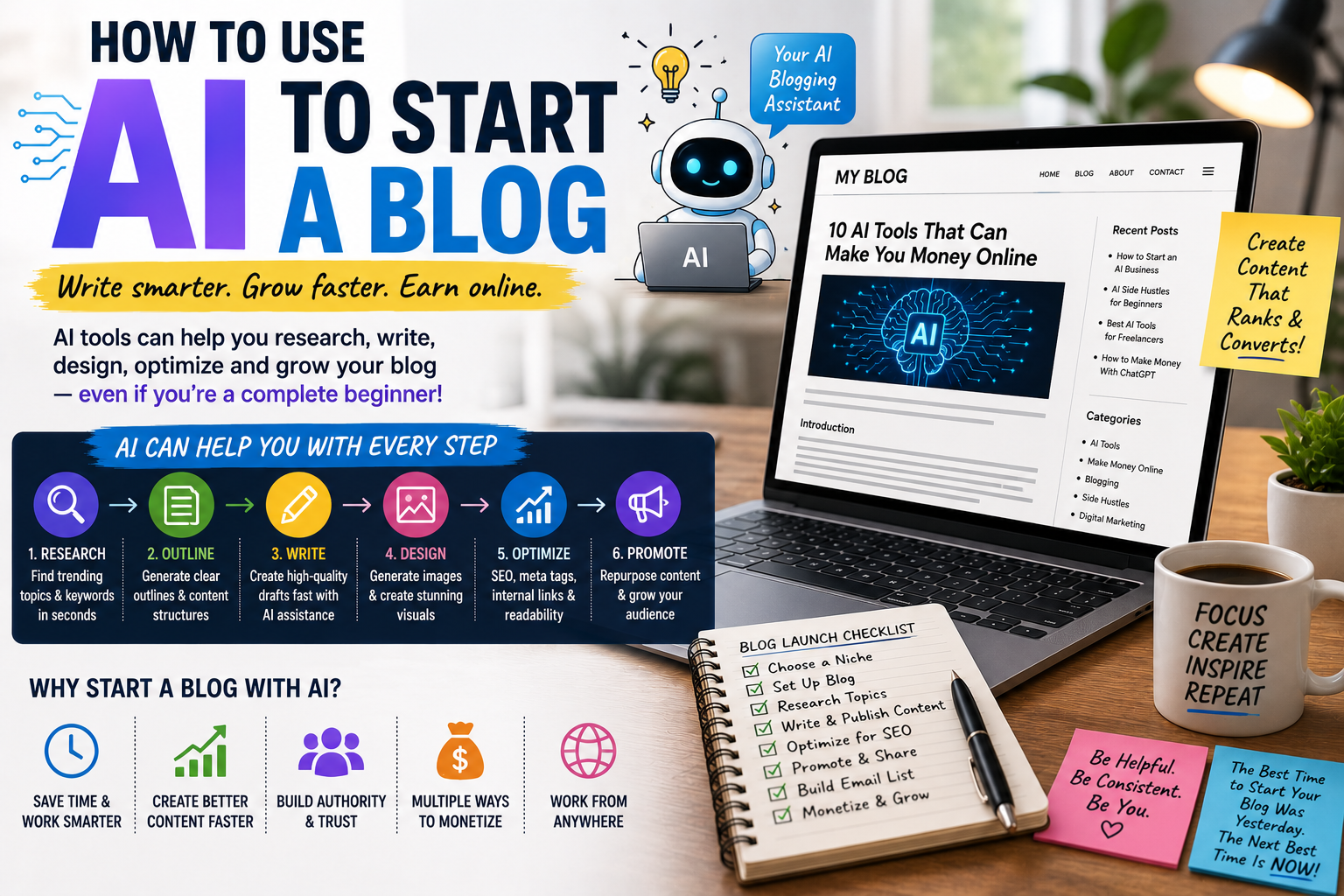
You don’t need to be a professional writer, SEO expert, or technology genius to start a blog anymore. With the right AI tools and a little human creativity, you can go from having an empty page to publishing useful content much faster than you might expect.
Starting a blog sounds easy.
Pick a topic.
Write some articles.
Publish them.
Wait for people to arrive.
Except… that’s not really how it works.
Anyone who has tried blogging seriously knows that the hardest part usually isn’t writing one article.
It’s consistently coming up with ideas.
Researching topics.
Creating good headlines.
Writing useful content.
Finding images.
Optimising articles for search engines.
Promoting your posts.
Updating old content.
And doing all of this again next week.
Then again the week after.
That’s where artificial intelligence can make a huge difference.
AI won’t magically turn a brand-new blog into a successful business overnight. It can’t replace good ideas, genuine expertise or an understanding of your readers.
But it can become an incredibly useful assistant.
Think of AI as the person sitting beside you saying:
“Here’s an idea.”
“Here’s an outline.”
“Here’s another angle you could explore.”
“I found a few things you should research.”
“This paragraph could be clearer.”
“Here are five ways to promote this article.”
Suddenly, blogging becomes much less intimidating.
And if you use AI correctly, you can spend less time staring at a blank screen and more time creating something people actually want to read.
Let’s look at how you can do it.
What Is an AI-Powered Blog?
An AI-powered blog isn’t necessarily a blog where every article is written entirely by artificial intelligence.
In fact, I wouldn’t recommend that approach.
Instead, think of it as a traditional blog where AI helps with different parts of the process.
For example:
You choose the topic.
↓
AI helps brainstorm ideas.
↓
You research the subject.
↓
AI helps organise your thoughts.
↓
You write and edit.
↓
AI helps improve clarity and structure.
↓
You fact-check and add your own perspective.
↓
You publish.
This combination can be extremely powerful.
The human provides judgement, personality and originality.
AI provides speed and assistance.
Why Start a Blog With AI?
Blogging has always been an attractive online business model because the basic barrier to entry is relatively low.
You don’t need a physical shop.
You don’t need employees.
You don’t need a warehouse full of products.
And you don’t necessarily need a huge amount of money.
What you do need is useful content and people who want to read it.
AI can make the content-production process considerably easier.
It can help you:
- Brainstorm ideas
- Research subjects
- Create outlines
- Draft content
- Rewrite awkward sentences
- Generate headlines
- Create FAQs
- Repurpose articles
- Create social media posts
- Develop email newsletters
- Generate image concepts
- Analyse content
- Find opportunities for improvement
But there’s an important catch.
AI makes creating content easier for everyone.
That means simply producing lots of content isn’t enough.
Your blog needs a reason for people to choose it.
The Biggest Mistake You Can Make
The easiest way to create a terrible AI blog is to ask an AI tool:
“Write me 100 blog posts about making money.”
Then publish everything without checking it.
Technically, you’ve created a blog.
But you’ve probably created something nobody really wants to read.
The internet already has an enormous amount of generic content.
AI can produce more of it very quickly.
Your advantage comes from doing something different.
Add:
- Your experiences
- Your opinions
- Examples
- Original research
- Personal stories
- Useful explanations
- Screenshots where appropriate
- Case studies
- Practical advice
Make the content feel like it was created by a person who actually cares about the subject.
Step 1: Choose a Blog Topic
Before you touch an AI tool, choose your niche.
A niche is simply the specific subject your blog focuses on.
You could blog about almost anything.
For example:
- Personal finance
- Technology
- AI
- Gaming
- Travel
- Fitness
- Food
- Fashion
- Education
- Career advice
- Productivity
- Business
- Hobbies
- Parenting
- Photography
The important thing is finding a topic you can realistically create content about for a long time.
Don’t Pick a Topic Just Because It’s Profitable
This is something many new bloggers get wrong.
They search:
“What’s the most profitable blog niche?”
Then choose something they don’t actually care about.
A few weeks later, they’re bored.
Blogging requires consistency.
So ask yourself:
Could I write about this for the next year?
If the answer is no, reconsider.
Find the Intersection Between Interest and Demand
A good blog topic often sits somewhere between:
Something you enjoy
Something people search for
Something you can eventually monetise
For example, perhaps you enjoy technology.
Instead of starting a generic technology blog, you might focus on:
AI tools for beginners.
Or:
Using AI to make money online.
That’s much more specific.
Go Narrow at First
You don’t need to compete with huge websites covering an entire industry.
You can start with a smaller audience.
For example, instead of:
“Business”
try:
“AI tools for small businesses.”
Instead of:
“Fitness”
try:
“Home workouts for beginners.”
Instead of:
“Technology”
try:
“Simple AI tutorials for non-technical people.”
The smaller topic gives your blog a clearer identity.
Step 2: Research Your Audience
Before writing hundreds of articles, figure out who you’re writing for.
Imagine your ideal reader.
What do they want?
What are they struggling with?
What questions do they ask?
What are they trying to achieve?
For example, if your blog is about making money with AI, your readers might want to know:
- Which AI tools are worth using?
- How can I make money with AI?
- Can I start without coding?
- What AI side hustles can beginners try?
- How much does it cost?
- Is AI-generated content actually useful?
- How do I get my first customer?
These questions can become blog posts.
Step 3: Use AI to Generate Blog Ideas
This is one of the easiest ways to use AI.
Instead of asking:
“Give me blog ideas.”
give the AI more context.
For example:
“I’m starting a blog for beginners who want to learn how to make money using AI. Give me 50 practical article ideas covering AI freelancing, side hustles, content creation, automation and digital products. Prioritise specific questions beginners are likely to have.”
The better your instructions, the more useful the output tends to be.
Build Content Clusters
Don’t think about individual articles only.
Think about groups of related articles.
For example, you might create a central article:
How to Make Money With AI
Then supporting articles:
- How to Make Money With ChatGPT
- How to Start an AI Freelancing Business
- 10 AI Side Hustles You Can Start With £0
- Best AI Tools for Freelancers
- How to Make Money Creating Social Media Content With AI
- How to Make Money With AI-Generated Images
- How to Start an AI Business With No Experience
- AI Side Hustles That Don’t Require Coding
Now your blog has a structure.
You’re not randomly publishing articles.
You’re building a resource.
Step 4: Research Before You Write
AI can help you brainstorm and organise information, but don’t treat it as your only source of truth.
For important information, research reliable sources yourself.
This is especially important when writing about:
- Money
- Laws
- Health
- Finance
- Technology specifications
- Current events
- Business regulations
- Product pricing
AI can sometimes produce information that sounds completely convincing while being wrong.
That’s one of the most dangerous things about it.
Confident writing isn’t the same thing as accurate writing.
Step 5: Create Your Article Outline With AI
Once you’ve chosen a topic, use AI to help structure it.
For example, if you’re writing:
How to Start a Blog With AI
your outline might look like:
- What an AI-powered blog is
- Choosing a niche
- Finding your audience
- Generating content ideas
- Researching topics
- Writing articles
- Creating images
- SEO optimisation
- Publishing
- Promoting your blog
- Monetising
- Common mistakes
- Long-term strategy
Now you’re no longer staring at a blank page.
You have a roadmap.
Step 6: Write the Article
This is where you need to be careful.
AI can write the first draft.
But don’t let it write the final version without your involvement.
Why?
Because AI doesn’t have your experiences.
It doesn’t know what you’ve learned.
It doesn’t have your personality.
It doesn’t understand your audience as well as you do.
And it doesn’t automatically know what is genuinely interesting.
Make Your Articles Sound Human
This is one of the most important parts of AI-assisted blogging.
Nobody wants to read an article that sounds like a machine.
Add personality.
Use natural language.
Tell stories.
Give opinions.
Use examples.
Explain things the way you’d explain them to a friend.
Instead of writing:
“Artificial intelligence has revolutionised the digital content ecosystem.”
you could simply say:
“AI has changed blogging dramatically. Tasks that used to take hours can now be completed much faster.”
Simple is often better.
Add Your Own Experiences
Suppose you’re writing about AI writing tools.
Don’t just list features.
Tell readers what actually happened when you used them.
For example:
“The first few drafts I generated sounded polished, but they also sounded strangely similar. Once I started giving the tool more context and editing the final draft myself, the results became much better.”
That’s human.
It gives the reader something they can relate to.
Don’t Be Afraid to Have an Opinion
Generic articles often try to please everyone.
Real people don’t.
If you genuinely believe one AI tool is better for beginners, explain why.
If you think a popular strategy doesn’t work, say so.
Just make sure your opinions are reasonable and clearly presented as opinions.
Step 7: Use AI for Editing
AI can be extremely useful after you’ve written an article.
You can ask it to:
- Find grammatical mistakes
- Improve clarity
- Shorten long sentences
- Identify repetition
- Suggest better headings
- Improve transitions
- Find areas that need explanation
But don’t accept every suggestion automatically.
You’re the editor.
Step 8: Create Blog Images With AI
Images can make articles easier to read and more visually appealing.
AI image-generation tools can help create:
- Featured images
- Illustrations
- Concept graphics
- Infographics
- Social media images
- Blog thumbnails
For example, an article called:
7 AI Side Hustles That Don’t Require Coding
could have a featured image showing a laptop, AI interface, creative tools and symbols representing freelancing and online income.
Don’t Use Random Images Just to Fill Space
Every image should have a purpose.
Ask:
“Does this help the reader?”
A relevant diagram can be much more useful than a generic stock photo of someone smiling at a laptop.
Step 9: Optimise Your Blog for Search Engines
Search engine optimisation, or SEO, is how you make your content easier for search engines to understand and potentially discover.
AI can help with the process.
It can help you identify:
- Related topics
- Search questions
- Potential headings
- FAQ ideas
- Internal linking opportunities
- Content gaps
But don’t turn your article into a pile of keywords.
Write for humans first.
Don’t Stuff Keywords Everywhere
Imagine your target keyword is:
“AI side hustles.”
You don’t need to write:
“The best AI side hustles are AI side hustles because AI side hustles can help you start AI side hustles…”
That’s terrible writing.
Use the phrase naturally.
Search engines have become much better at understanding context.
Write Better Headlines
Your headline determines whether someone clicks.
Compare:
“Artificial Intelligence and Blogging”
with:
“How to Use AI to Start a Blog in 2026: A Beginner’s Guide”
The second tells the reader exactly what they’ll learn.
Useful headline formulas include:
- How to ___
- X Ways to ___
- Beginner’s Guide to ___
- X Mistakes to Avoid When ___
- How I ___
- X Tools for ___
- The Complete Guide to ___
- Is ___ Worth It?
Step 10: Make Your Blog Easy to Read
Online readers don’t usually read every word.
They scan.
That’s why formatting matters.
Use:
- Short paragraphs
- Clear headings
- Bullet points
- Tables
- Bold text where useful
- Images
- Examples
- Plenty of white space
A 2,500-word article can feel easy to read when it’s properly structured.
Step 11: Create Internal Links
Once you’ve published multiple articles, connect them.
For example:
Your article about:
How to Start an AI Business
could link to:
7 AI Side Hustles That Don’t Require Coding
which could link to:
Best AI Tools for Freelancers
which could link to:
How to Make Money With ChatGPT
This helps readers discover more of your content.
It also creates a stronger overall website structure.
Step 12: Promote Your Articles
Publishing an article isn’t the end.
It’s the beginning.
You need people to discover it.
AI can help you turn one blog post into multiple pieces of content.
For example:
One blog post
↓
3 LinkedIn posts
↓
5 X posts
↓
3 Instagram captions
↓
1 email newsletter
↓
1 short video script
↓
5 Pinterest-style graphics
↓
1 YouTube video outline
Suddenly, one article becomes an entire content campaign.
This Is Where AI Gets Really Powerful
Imagine you spend several hours creating one excellent article.
Instead of letting it sit on your website, you can repurpose it.
AI can help you transform the article into different formats.
You’re not creating everything from scratch.
You’re getting more value from work you’ve already done.
Step 13: Build an Email List
Don’t rely entirely on search engines.
You don’t control Google.
You don’t control social media algorithms.
But an email list gives you a direct way to communicate with people who have chosen to hear from you.
Offer something useful in exchange for an email address.
For example:
“50 AI Prompts for Freelancers”
or:
“Beginner’s Guide to Making Money With AI.”
Then send useful emails.
Don’t constantly spam people with sales pitches.
Step 14: Monetise Your Blog
There are several ways a blog can eventually make money.
You don’t need to use all of them.
1. Advertising
You can display advertisements on your website.
You generally need meaningful traffic before advertising becomes particularly interesting financially.
Don’t expect a brand-new blog with 20 visitors to generate a fortune from ads.
2. Affiliate Marketing
Affiliate marketing involves recommending products or services and potentially earning a commission when someone makes a qualifying purchase through your referral.
For example, a technology blog might recommend:
- Software
- AI tools
- Hosting services
- Online courses
- Productivity products
Always disclose affiliate relationships where required.
And don’t recommend something simply because it pays a commission.
Your readers need to trust you.
3. Digital Products
You can eventually sell your own products.
For example:
- Ebooks
- Templates
- Prompt packs
- Courses
- Checklists
- Guides
- Notion templates
- Spreadsheets
- Digital toolkits
This can be attractive because you create the product once and can potentially sell it repeatedly.
4. Services
Your blog can also generate customers for a service business.
For example, if you write about AI marketing, you could offer:
- AI consulting
- Content creation
- Social media management
- AI automation
- Video editing
- Freelancing services
Your blog becomes a marketing channel.
5. Sponsorships
Once you build an audience, companies may become interested in sponsoring:
- Articles
- Newsletters
- Videos
- Podcasts
- Other content
This tends to become more realistic as your audience grows.
Don’t Monetise Too Early
This is an underrated piece of advice.
If your website contains five articles and immediately has ten advertisements, affiliate links everywhere and constant sales messages, visitors may wonder:
“What am I actually getting from this website?”
Give people value first.
Build trust.
Then monetise naturally.
How Long Does It Take to Make Money Blogging?
There is no guaranteed timeline.
Some blogs earn money quickly.
Others take months or years.
Many never make meaningful money.
That’s the honest answer.
Blogging is not a guaranteed income machine.
Your results depend on factors including:
- Topic
- Content quality
- Competition
- Search demand
- Promotion
- Consistency
- Monetisation strategy
- Audience
- Website quality
Anyone promising guaranteed blogging income should be treated with caution.
Don’t Measure Success Only by Money
Especially at the beginning.
Track things like:
- Articles published
- Organic visitors
- Email subscribers
- Search impressions
- Search clicks
- Returning visitors
- Social engagement
- Affiliate clicks
- Leads
- Sales
These numbers tell you what’s working.
Your First 10 Articles
Don’t obsess about publishing 100 articles immediately.
Create your first ten strategically.
For example:
Article 1
A comprehensive beginner guide.
Article 2
A practical how-to tutorial.
Article 3
A tools comparison.
Article 4
A list of ideas.
Article 5
A common mistakes article.
Article 6
A beginner’s guide.
Article 7
A case study.
Article 8
A problem-solving article.
Article 9
A comparison.
Article 10
An advanced guide.
Now you’ve created a foundation.
Your First 50 Articles
Once you have a clear content strategy, you can scale.
Use AI to help organise your editorial calendar.
For example:
Monday: Research
Tuesday: Write
Wednesday: Edit
Thursday: Publish
Friday: Promote
Or create your own schedule.
The important thing is consistency you can actually maintain.
Don’t Publish Just Because You Have an AI Tool
AI can generate endless ideas.
That’s both a benefit and a problem.
You could generate 500 article ideas in minutes.
But you don’t need 500 bad articles.
You need fewer, better articles.
Before publishing, ask:
Would I actually recommend this article to someone who asked me for advice?
If the answer is no, improve it.
Use AI to Find Content Gaps
Suppose you have ten articles about AI freelancing.
Ask:
- What questions haven’t I answered?
- What would a beginner still be confused about?
- What topics naturally come next?
- What comparisons would help readers?
- What practical examples are missing?
This can help you build a more complete resource.
Update Your Old Articles
One of the easiest ways to improve an existing blog is to revisit older content.
AI can help you identify:
- Outdated sections
- Broken logic
- Repeated information
- Missing questions
- Weak headings
- Opportunities to add examples
If an article was published two years ago, don’t assume it’s still perfect.
Update it.
Create a Content Refresh System
Every few months, review your important articles.
Ask:
Is the information still accurate?
Are the links still working?
Can I add something useful?
Can I improve the introduction?
Can I answer newer questions?
This can be more valuable than constantly publishing new content.
AI Can Help You Build a Content Calendar
You could ask AI to create a 90-day calendar based on:
- Your niche
- Your audience
- Your existing articles
- Seasonal topics
- Beginner questions
- Advanced questions
- Commercial topics
Then organise the ideas yourself.
Don’t blindly follow the AI’s schedule.
Use it as a starting point.
Create Different Types of Content
A healthy blog shouldn’t consist entirely of listicles.
Mix things up.
Tutorials
“How to…”
Guides
“The Complete Guide to…”
Comparisons
“X vs Y”
Case Studies
“How I…”
Opinion Pieces
“Why I Think…”
Lists
“10 Ways…”
Explanations
“What Is…”
Reviews
“Is X Worth It?”
Different formats keep your blog interesting.
Build Trust With Your Readers
Trust is everything.
Don’t pretend to have experience you don’t have.
Don’t invent statistics.
Don’t make up customer stories.
Don’t publish fake testimonials.
Don’t exaggerate earnings.
If you haven’t personally tested something, say so.
There’s nothing wrong with saying:
“I haven’t tested this tool myself, but here’s what the available information suggests.”
Honesty makes your content more credible.
Don’t Let AI Invent Your Expertise
This is a major problem.
AI can write:
“After years of running successful blogs…”
even if you have never run a blog before.
Don’t publish claims like that.
AI doesn’t know your life.
It will sometimes fill gaps with plausible-sounding language.
Check everything.
Create a Human Editorial Process
A simple process could be:
Step 1
Choose topic.
Step 2
Research.
Step 3
Create outline.
Step 4
Draft.
Step 5
Add personal insights.
Step 6
Fact-check.
Step 7
Edit.
Step 8
Optimise for search.
Step 9
Add images.
Step 10
Publish.
Step 11
Promote.
Step 12
Review performance.
AI can assist with many of these steps.
But you remain in control.
A Simple AI Blogging Workflow
Here’s what a typical article could look like.
1. Find a question people care about.
↓
2. Research the question.
↓
3. Ask AI for potential angles.
↓
4. Create an outline.
↓
5. Write the first draft.
↓
6. Add your own insights and examples.
↓
7. Fact-check important claims.
↓
8. Edit the article.
↓
9. Create a featured image.
↓
10. Optimise title and headings.
↓
11. Publish.
↓
12. Repurpose for social media.
↓
13. Monitor performance.
That’s an efficient content machine.
How AI Can Save Bloggers Time
Imagine the old process takes:
- 30 minutes brainstorming
- 60 minutes researching
- 30 minutes outlining
- 2 hours writing
- 30 minutes editing
- 30 minutes creating social content
That’s almost six hours.
With an efficient AI-assisted workflow, you may be able to reduce the time spent on certain repetitive tasks significantly.
But don’t think:
“AI means I can produce six times as many articles.”
Think:
“AI gives me more time to make each article better.”
That’s a much healthier approach.
Quality Beats Quantity
This deserves its own section.
The internet doesn’t need another thousand generic articles explaining:
“What is AI?”
It needs useful content.
Content that answers questions properly.
Content that saves people time.
Content that teaches something.
Content that makes a reader think:
“That actually helped.”
That’s what you should aim for.
Common AI Blogging Mistakes
Mistake 1: Publishing Raw AI Content
Don’t.
Edit it.
Mistake 2: Making Every Article Sound the Same
Vary your writing.
Add personality.
Mistake 3: Ignoring Fact-Checking
AI can be wrong.
Verify important information.
Mistake 4: Chasing Every Trend
Not every AI trend deserves an article.
Stay focused on your audience.
Mistake 5: Publishing for Search Engines Instead of Humans
Write for people.
Mistake 6: Choosing a Huge Niche
Start narrower.
Mistake 7: Giving Up Too Early
Blogs often take time.
Mistake 8: Expecting AI to Do Everything
You’re building the business.
AI is the assistant.
A 30-Day Plan to Start Your AI Blog
If you want to stop reading and actually start, here’s a simple challenge.
Days 1-3: Choose Your Niche
Write down five possible topics.
Choose one.
Days 4-5: Define Your Audience
Describe the person you’re writing for.
What do they want?
What problems do they have?
Days 6-7: Create Your Content Strategy
Come up with 30–50 article ideas.
Group them into categories.
Days 8-10: Set Up Your Blog
Choose your blogging platform.
Create:
- Homepage
- About page
- Contact page
- Privacy-related pages where appropriate
- Main categories
Keep the design clean.
Days 11-15: Write Your First Three Articles
Don’t worry about perfection.
Focus on being genuinely useful.
Days 16-20: Create More Content
Publish several additional articles.
Start building your content library.
Days 21-23: Create Social Accounts
Choose platforms that make sense for your audience.
Don’t feel like you need to be everywhere.
Days 24-26: Repurpose Your Articles
Turn your blog posts into:
- Social posts
- Short videos
- Emails
- Graphics
Days 27-28: Start Building Your Email List
Create a useful free resource.
Days 29-30: Review Everything
Look at:
- Your content
- Your website
- Your headlines
- Your social strategy
- Your monetisation options
Then plan the next 30 days.
What You Should Do After 30 Days
Don’t stop.
That’s when the real work begins.
Continue publishing.
Keep learning.
Analyse what’s working.
Improve old content.
Build your email list.
Experiment with promotion.
Start testing monetisation when you have an audience and something genuinely useful to offer.
Can AI Help You Make Money From Your Blog?
Yes-but not in the magical way some online advertisements suggest.
AI doesn’t guarantee traffic.
It doesn’t guarantee rankings.
It doesn’t guarantee affiliate sales.
It doesn’t guarantee advertising revenue.
What it can do is help you build faster and work more efficiently.
You still need:
Good content + audience + trust + distribution + monetisation.
AI simply gives you another tool.
Think of AI as Your Blogging Assistant
This is probably the best way to think about it.
You are the editor-in-chief.
AI is the assistant.
You decide:
- What your blog stands for
- Who you want to help
- What topics matter
- What opinions you hold
- What gets published
AI can help you:
- Brainstorm
- Organise
- Draft
- Edit
- Repurpose
- Research
- Improve
That division of labour works much better than handing your entire blog over to AI.
The Future of Blogging Isn’t “Human vs AI”
It’s probably going to be:
Humans using AI well vs humans using AI badly.
Anyone can generate text.
The advantage will come from people who can take AI-generated possibilities and turn them into something genuinely valuable.
That means:
- Better ideas
- Better research
- Better storytelling
- Better editing
- Better judgement
- Better audience understanding
AI makes production easier.
It doesn’t automatically make content good.
Final Thoughts
Starting a blog can feel overwhelming.
There are so many decisions.
What should you write about?
What platform should you use?
How often should you publish?
How do you get traffic?
How do you make money?
And now there’s another question:
“How should I use AI?”
The answer doesn’t have to be complicated.
Start small.
Choose one topic.
Choose one audience.
Create useful content.
Use AI to make the process easier.
But keep your human voice at the centre of everything.
Don’t try to publish 1,000 articles.
Try to publish 10 articles that are genuinely helpful.
Then 20.
Then 50.
Learn what your readers respond to.
Improve.
Build an audience.
Create trust.
Eventually, explore ways to monetise that attention.
The Bottom Line
AI has made starting a blog easier-but it hasn’t made building a successful blog automatic.
The technology can help you overcome some of the biggest barriers to blogging.
It can help you come up with ideas when you’re stuck.
It can help you organise complicated subjects.
It can speed up writing and editing.
It can help you create images.
It can repurpose your content.
It can even help you build a repeatable publishing system.
But your biggest advantage isn’t the AI tool you use.
It’s what you bring to the table.
Your perspective.
Your curiosity.
Your experiences.
Your ability to explain something clearly.
Your understanding of your readers.
Your willingness to research instead of guessing.
And your commitment to creating something genuinely useful.
So don’t wait until you’ve found the perfect niche, the perfect website design or the perfect AI workflow.
Pick a topic.
Write your first useful article.
Publish it.
Learn from it.
Then write the next one.
Because the best time to start building your blog isn’t when you know everything.
It’s when you’re ready to learn as you go.