
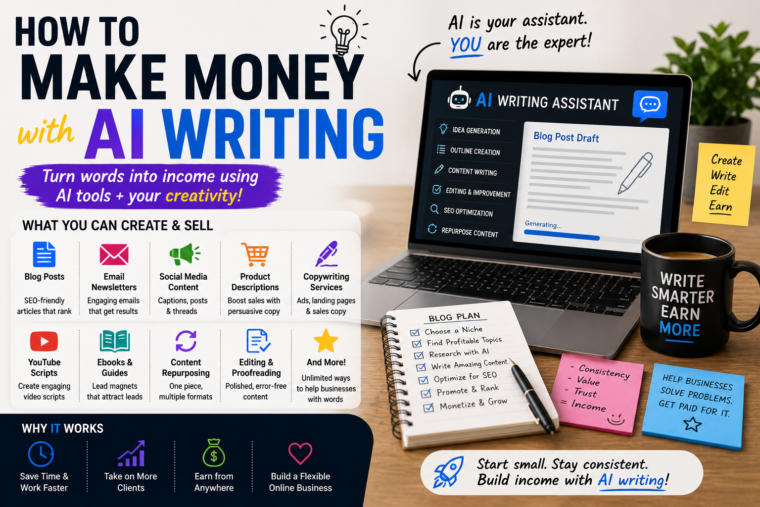
AI has changed the way people write.
A few years ago, if you wanted to make money writing online, you usually needed strong writing skills, a portfolio, a laptop, and plenty of patience. You might spend hours researching a topic, writing an article, editing it, creating social media posts, and then hoping someone would actually pay you for the work.
Today, things look very different.
Tools powered by artificial intelligence can help you brainstorm ideas, create outlines, rewrite awkward sentences, research topics, generate drafts, write marketing copy, and even repurpose one piece of content into multiple formats.
That doesn’t mean AI has made writers unnecessary.
In fact, it has created a new opportunity.
People who know how to use AI effectively can offer writing services faster and potentially serve more clients than they could on their own.
And you don’t necessarily need to be a professional writer to get started.
You do, however, need to understand something important:
You’re not really selling AI writing. You’re selling useful content that happens to be created with the help of AI.
That’s the difference between someone who simply types a prompt into ChatGPT and someone who can build a genuine AI writing business.
In this guide, we’ll look at practical ways you can make money with AI writing, what services you can sell, how to find clients, how much you might charge, what tools you can use, common mistakes to avoid, and how you can turn AI writing from a simple side hustle into a real online business.
What Is AI Writing?
AI writing is the process of using artificial intelligence tools to assist with creating written content.
Depending on the tool and your instructions, AI can help produce things such as:
- Blog posts
- Website copy
- Product descriptions
- Social media captions
- Email newsletters
- Marketing emails
- Advertisements
- YouTube scripts
- Video descriptions
- LinkedIn posts
- Sales pages
- Newsletters
- Ebooks
- Lead magnets
- Business proposals
- SEO content
- Content ideas
- Headlines
- FAQs
- Customer-service responses
Popular AI assistants can generate a first draft in seconds.
But here’s where beginners often get it wrong.
They assume the business opportunity is simply:
Prompt → AI generates article → Send article to client → Get paid.
It isn’t.
If you do that, you’re competing with thousands of other people doing exactly the same thing.
The real opportunity is:
AI + human judgment + research + editing + creativity + understanding the customer = valuable content.
AI gives you speed.
You provide the thinking.
Why AI Writing Is Such an Interesting Money-Making Opportunity
Think about how much writing a typical business needs.
A small business might need:
- Website pages
- Google Business Profile posts
- Facebook captions
- Instagram captions
- Blog articles
- Email campaigns
- Product descriptions
- Promotional messages
- Advertisements
- Frequently asked questions
The business owner may know their industry extremely well.
But that doesn’t mean they enjoy writing.
And many business owners simply don’t have time to sit down and produce content every week.
That’s where you can come in.
Instead of selling yourself as:
“I use AI to write articles.”
You can position yourself as:
“I help small businesses create consistent, professional content without having to spend hours writing it themselves.”
That’s a much stronger offer.
You’re solving a problem.
And businesses pay people to solve problems.
10 Ways to Make Money With AI Writing
There are many ways to turn AI-assisted writing into income.
You don’t need to do all of them.
In fact, I’d recommend starting with one or two services, learning them properly, and then expanding once you’re comfortable.
Here are some of the most realistic options.
1. Write Blog Posts for Businesses
One of the easiest places to start is blogging.
Businesses need blog content for several reasons.
A useful blog can help a company:
- Attract people from search engines
- Answer customer questions
- Demonstrate expertise
- Build trust
- Promote products
- Generate leads
- Keep its website active
The problem is that consistently writing good blog posts takes time.
AI can dramatically speed up the process.
For example, imagine a local gardening company.
You could create articles such as:
- “10 Easy Ways to Improve Your Garden”
- “How Often Should You Water Your Lawn?”
- “Best Plants for Small Gardens”
- “How to Prepare Your Garden for Winter”
- “Common Gardening Mistakes to Avoid”
AI can help you brainstorm topics, create an outline, produce an initial draft, and suggest headings.
You then improve the article.
Add real information.
Check the facts.
Make the writing sound natural.
Add examples.
Include the company’s expertise.
And make sure the article actually helps the reader.
How you can charge
You might offer packages such as:
Starter
- 2 blog posts per month
- Basic research
- AI-assisted writing
- Editing
Growth
- 4 blog posts per month
- Topic research
- SEO optimization
- Images
- Meta descriptions
Premium
- 8+ posts per month
- Content strategy
- Keyword research
- Internal linking
- Content updates
- Social media repurposing
Your exact pricing depends on your experience, niche, quality, research requirements, and the value you’re providing.
Don’t automatically charge extremely low prices just because AI makes your work faster.
If you can produce something genuinely useful in one hour that previously took you four hours, the client is still paying for the result, not the number of minutes you spent typing.
2. Offer AI Copywriting Services
Blogging isn’t the only type of writing businesses need.
Copywriting is another huge opportunity.
Copywriting is writing designed to persuade someone to take an action.
That action could be:
- Buying something
- Booking an appointment
- Joining an email list
- Requesting a quote
- Signing up for a service
- Downloading something
- Clicking a button
Examples include:
- Website headlines
- Landing pages
- Sales pages
- Advertisements
- Product descriptions
- Email campaigns
- Promotional messages
AI can be particularly useful for generating different versions of marketing copy.
For example, you might ask AI to create:
- Five headline ideas
- Three calls to action
- Several variations of an advertisement
- Different tones for different audiences
- Short and long versions of the same message
But you still need to understand why the copy works.
Good copy isn’t just about putting impressive words on a page.
It’s about understanding the customer.
What do they want?
What problem are they experiencing?
What objections might they have?
Why should they trust the company?
Why should they act now?
AI can help you explore those questions, but you should be the person making the final decisions.
3. Create Social Media Content With AI
This is another excellent opportunity because businesses constantly need social media content.
A business might want:
- Instagram captions
- Facebook posts
- LinkedIn posts
- TikTok captions
- Promotional posts
- Educational posts
- Customer FAQs
- Story ideas
- Content calendars
Instead of selling one caption at a time, create a monthly content package.
For example:
Monthly Social Content Package
- 20 social media posts
- 10 promotional captions
- 5 educational posts
- 5 engagement posts
- Hashtag suggestions
- Monthly content calendar
AI can help you generate the initial ideas and drafts.
You can then personalize everything around the business.
For example, a local restaurant shouldn’t receive generic posts that could belong to any restaurant in the world.
You could incorporate:
- Their menu
- Their location
- Their customers
- Seasonal events
- Special offers
- Staff stories
- Customer questions
- Behind-the-scenes content
That’s what makes the content feel human.
4. Write Email Newsletters
Email marketing is another area where businesses need consistent writing.
Imagine owning an online store.
Every week, you might want to send customers an email about:
- A new product
- A discount
- A seasonal promotion
- Helpful advice
- A company update
- A customer story
- A special event
Coming up with ideas every week can become exhausting.
AI can help you create a repeatable workflow.
For example:
Step 1: Choose the purpose of the email.
Step 2: Identify the audience.
Step 3: Give AI the necessary information.
Step 4: Generate several subject-line ideas.
Step 5: Create a draft.
Step 6: Rewrite it in the company’s voice.
Step 7: Add the offer or call to action.
Step 8: Proofread everything.
Step 9: Check links, names, prices and claims.
The result is much better than simply telling AI:
“Write me an email.”
The more context you provide, the more useful the output tends to become.
5. Create Product Descriptions
E-commerce businesses can have hundreds or even thousands of products.
Writing individual descriptions can take a huge amount of time.
This creates an opportunity for AI-assisted product writing.
You could help businesses create:
- Product titles
- Product descriptions
- Short descriptions
- Feature lists
- FAQs
- SEO descriptions
- Category descriptions
- Promotional copy
For example, instead of giving AI a vague instruction, you could provide:
- Product name
- Product features
- Materials
- Size
- Target customer
- Benefits
- Brand voice
- Important specifications
Then ask AI to create several versions.
You edit the results and make sure every technical detail is accurate.
This last part is extremely important.
Never assume an AI-generated product specification is correct.
If the product is waterproof, say so because the manufacturer confirms it-not because AI guessed it.
6. Write YouTube Scripts
YouTube creators need content constantly.
But creating videos involves much more than recording yourself.
Creators may need:
- Video ideas
- Hooks
- Scripts
- Introductions
- Explanations
- Stories
- Calls to action
- Video descriptions
- Titles
- Short-form versions
AI can help you speed up much of this process.
For example, you could offer a creator:
“I’ll turn your video idea into a complete YouTube script.”
You could also offer a bigger package:
YouTube Content Package
- 4 video ideas
- 4 scripts
- 4 video descriptions
- 20 short-form content ideas
- Titles and hooks
This turns a simple writing service into a more valuable content service.
7. Offer LinkedIn Writing Services
LinkedIn has become an important platform for professionals, consultants, founders and businesses.
But many people don’t know what to post.
Or they have ideas but don’t know how to turn them into engaging posts.
That’s where AI-assisted writing can help.
You could create LinkedIn posts based on:
- Their experiences
- Their opinions
- Industry trends
- Lessons they’ve learned
- Customer stories
- Business achievements
- Case studies
- Educational topics
The key here is personalization.
Don’t make someone’s LinkedIn account sound like a corporate robot.
If a client tells you:
“I nearly lost my first business because I hired too quickly.”
That’s potentially a story.
You can help turn that experience into a compelling post.
The human experience comes from the client.
AI simply helps you shape the words.
8. Create Ebooks and Lead Magnets
Businesses often use free resources to attract potential customers.
These resources are sometimes called lead magnets.
Examples include:
- Checklists
- Guides
- Ebooks
- Workbooks
- Templates
- Cheat sheets
- Industry reports
- Beginner’s guides
For example, a personal trainer might offer:
“The Beginner’s 7-Day Fitness Guide.”
A financial adviser might offer:
“A Beginner’s Guide to Organizing Your Finances.”
A marketing agency might offer:
“25 Social Media Ideas for Small Businesses.”
AI can help with research, organization and drafting.
You can then edit and structure the content into a professional resource.
If you also know how to use design tools, you can create an even more valuable service:
Research + AI writing + editing + design.
Now you’re not just selling words.
You’re selling a finished digital product.
9. Offer Content Repurposing
This is one of my favorite AI writing opportunities.
Businesses already have content.
They just aren’t using it effectively.
Imagine a business owner records a 20-minute podcast.
You could turn that one piece of content into:
- A blog post
- 5 LinkedIn posts
- 10 social media captions
- An email newsletter
- Several short-video ideas
- A list of quotes
- An FAQ
- A YouTube description
AI can make this process significantly faster.
Your service becomes:
“Give me one piece of content and I’ll turn it into an entire week’s worth of marketing material.”
That’s a much more compelling offer than:
“I write AI content.”
10. Start an AI Writing Agency
Once you’ve built experience and have regular clients, you can take things further.
Instead of doing every task yourself, you can build a small content agency.
You could offer:
- Blog writing
- Copywriting
- Social media content
- Email marketing
- YouTube scripts
- SEO content
- Content repurposing
AI becomes part of your internal workflow.
You could eventually work with other writers, editors, designers or virtual assistants.
At that point, you’re no longer simply freelancing.
You’re building a business.
How Much Money Can You Make With AI Writing?
This is where it’s important to be realistic.
There isn’t a guaranteed amount of money you can make with AI writing.
Someone might make a few pounds from their first small project.
Another person might eventually build a substantial freelance business.
Your income depends on things such as:
- Your writing ability
- Your niche
- The services you offer
- Your ability to find clients
- Your pricing
- Your portfolio
- The quality of your work
- Your communication skills
- Your ability to retain clients
- How much time you have available
One of the biggest mistakes beginners make is focusing entirely on how quickly they can produce content.
Instead, focus on how valuable the finished product is.
If you can help a business attract customers, save employees time, improve its website, or communicate more effectively, your service becomes much more valuable.
Don’t Compete on Price Alone
It’s tempting to advertise:
“I’ll write 1,000 words for £5!”
But that can become a race to the bottom.
There will always be someone willing to charge less.
Instead, compete on value.
Rather than:
“I write blog posts.”
Try:
“I help local businesses publish useful, search-friendly blog content every month so they can answer customer questions and attract more potential customers.”
That’s a completely different proposition.
You’re selling an outcome.
The AI Writing Tools You Can Use
You don’t need dozens of expensive tools.
A relatively simple toolkit can be enough to get started.
AI Writing Assistant
Use an AI assistant to help with:
- Brainstorming
- Outlines
- Drafts
- Rewriting
- Summaries
- Headlines
- Ideas
- Content repurposing
Grammar and Editing Tools
Use editing software to catch:
- Spelling mistakes
- Grammar problems
- Awkward sentences
- Repetition
- Readability issues
Design Tools
A design platform can help you create:
- Blog graphics
- Social media posts
- Lead magnets
- PDFs
- Presentations
- Thumbnails
Research Tools
Use reliable sources to verify facts and gather information.
Don’t allow AI to become your only research source.
How to Build an AI Writing Workflow
One of the biggest advantages of AI is speed.
But speed only matters when you have a good process.
Here’s a simple workflow you can use.
Step 1: Understand the Client
Before writing anything, learn:
- Who is the business?
- Who are its customers?
- What does it sell?
- What makes it different?
- What tone does it use?
- What does the customer need?
- What action should the reader take?
This information is incredibly valuable.
Step 2: Research the Topic
Don’t immediately ask AI to write.
Research first.
Look at:
- Reliable websites
- Industry publications
- Official sources
- Competitors
- Customer questions
- Existing company material
Your goal is to understand the subject.
Step 3: Create an Outline
Use AI to brainstorm a structure.
For example:
Topic: How to Save Money on Home Energy
Possible structure:
- Introduction
- Why energy bills are expensive
- Simple ways to reduce usage
- Heating tips
- Appliance tips
- Insulation
- Common mistakes
- Final checklist
Now you have a framework.
Step 4: Generate a First Draft
Give AI enough context.
Tell it:
- Who the audience is
- What the article should achieve
- What tone to use
- Important facts
- Desired structure
- What to avoid
- What call to action to include
The result should be treated as a first draft, not a finished product.
Step 5: Humanize the Content
This is where you can separate yourself from low-quality AI writers.
Read the content carefully.
Ask:
Does this actually sound like a person wrote it?
Look for phrases that feel generic.
For example:
“In today’s fast-paced digital world…”
You don’t always need sentences like that.
Start naturally.
Instead of:
“In today’s fast-paced digital world, businesses are increasingly looking for innovative solutions…”
You might write:
“Most small business owners don’t need another complicated marketing system. They need something that saves them time and actually gets done.”
That feels more direct.
More conversational.
More human.
Step 6: Add Your Own Ideas
Don’t just edit grammar.
Add substance.
Include:
- Examples
- Personal observations
- Case studies
- Customer questions
- Industry-specific details
- Practical tips
- Contrarian ideas
- Stories
This is where human judgment becomes valuable.
Step 7: Fact-Check Everything
This step should never be skipped.
AI can confidently produce information that sounds believable but isn’t correct.
Check:
- Statistics
- Dates
- Names
- Prices
- Product specifications
- Legal information
- Medical claims
- Financial information
- Scientific claims
- Quotes
- Sources
If something matters, verify it.
Step 8: Edit Again
Your first editing pass catches obvious problems.
Your second pass improves the writing.
Remove:
- Repetition
- Unnecessary headings
- Filler
- Awkward phrases
- Excessive adjectives
- Generic statements
Then read the piece as if you’re the customer.
Would you actually find it useful?
If not, improve it.
Step 9: Deliver Something Better Than Expected
This is how you build repeat clients.
Don’t simply deliver the article.
You could also include:
- Suggested headline
- Meta description
- Social media caption
- Image suggestion
- Internal-link suggestions
- Call-to-action ideas
You can turn one writing task into a more complete content package.
How to Find Your First AI Writing Client
This is usually harder than learning the AI tools.
And that’s completely normal.
Knowing how to write doesn’t automatically mean people will find you.
You have to actively look for opportunities.
Method 1: Contact Local Businesses
This is one of the easiest places to start.
Look for businesses that have:
- Outdated websites
- Inactive blogs
- Weak social media
- Poor product descriptions
- No email newsletter
- Few Google Business updates
- Basic website copy
Potential niches include:
- Restaurants
- Salons
- Gyms
- Estate agents
- Tradespeople
- Accountants
- Dentists
- Coaches
- Consultants
- Online stores
- Local service businesses
Don’t send hundreds of identical spam messages.
Find businesses where you can genuinely identify something they could improve.
Then explain how you can help.
Method 2: Freelance Platforms
You can also look for writing work on freelance marketplaces.
Search for services such as:
- Blog writing
- Copywriting
- SEO writing
- Email writing
- Social media writing
- Product descriptions
- Script writing
- Content creation
The competition can be high.
That’s why specialization helps.
Instead of:
“I am an AI writer.”
Try something like:
“I create blog content for small home-improvement businesses.”
A specific offer is easier for potential clients to understand.
Method 3: Build Your Own Content
If you want people to trust you as a writer, demonstrate that you can write.
Start your own:
- Blog
- LinkedIn account
- Newsletter
- Website
- Social media page
Write about your chosen niche.
This gives you examples to show potential clients.
You don’t need to wait until someone hires you to build a portfolio.
Create the portfolio first.
Method 4: Offer a Free Sample
You don’t necessarily need to work for free.
Instead, create a short sample.
For example:
“I noticed your website doesn’t have an article answering this common customer question, so I created a short sample showing what it could look like.”
Then send the sample.
This demonstrates initiative.
But be careful about giving away huge amounts of unpaid work.
A sample should demonstrate your ability-not become an entire free project.
Create a Simple AI Writing Portfolio
You don’t need an expensive website when you’re starting.
A simple portfolio can contain:
About Me
A short introduction.
Services
Explain what you offer.
Samples
Include 3–5 strong examples.
Packages
Give potential clients an idea of what they can buy.
Contact
Make it easy to reach you.
Your samples could include:
- A blog article
- A sales page
- An email campaign
- A social media content package
- A product description
Even if these weren’t created for real clients, you can label them as sample/spec work.
How to Write a Good AI Prompt
A vague prompt produces vague content.
Instead of:
“Write a blog post about gardening.”
Give AI context.
For example:
“Create an outline for a beginner-friendly blog article about maintaining a small garden. The audience is UK homeowners with limited gardening experience. The tone should be friendly, practical and conversational. Focus on affordable tips that don’t require specialist equipment. Avoid exaggerated claims and unnecessary technical language.”
That’s much more useful.
A strong prompt usually gives AI:
Context + Audience + Goal + Format + Tone + Constraints
A Simple Prompt Formula
You can use this formula for almost anything:
Act as [role]. Create [content] for [audience]. The goal is [goal]. Use a [tone] tone. Include [important information]. Structure it as [format]. Avoid [things you don’t want].
For example:
“Act as an experienced content strategist. Create a 1,500-word blog article for small business owners who want to improve their social media marketing. The goal is to give beginners practical steps they can implement immediately. Use a friendly, conversational tone. Include examples and common mistakes. Avoid unnecessary jargon and exaggerated promises.”
Then refine the output.
The Secret to Better AI Writing: Give It More Context
AI becomes much more useful when it understands the situation.
Compare:
Prompt A:
“Write a Facebook post about my restaurant.”
With:
Prompt B:
“Write a Facebook post for a family-owned Italian restaurant in Manchester. The restaurant specializes in homemade pasta and traditional Italian dishes. The target audience is local families and couples aged 25–55. We’re promoting a midweek pasta special this Thursday. Keep the tone warm and inviting and end with a clear booking call to action.”
The second prompt gives the AI something to work with.
The lesson is simple:
Better input usually leads to better output.
Don’t Hide the Human Part
There’s a strange misconception that successful AI writing means making the AI output look completely untouched.
I’d argue the opposite.
The best AI-assisted content often has plenty of human involvement.
You might:
- Interview the client
- Research the topic
- Develop the strategy
- Create the outline
- Use AI for brainstorming
- Rewrite sections
- Add examples
- Fact-check information
- Improve the voice
- Add original insights
- Edit the final piece
AI handles some of the repetitive work.
You handle the judgment.
Common Mistakes to Avoid
Mistake #1: Publishing Raw AI Content
This is probably the biggest mistake.
Generating an article and immediately publishing it isn’t a business strategy.
AI-generated drafts can contain:
- Repetition
- Generic language
- Incorrect information
- Weak examples
- Unnatural phrasing
- Missing context
Always review the output.
Mistake #2: Trying to Be an Expert in Everything
You don’t need to write about every topic imaginable.
Choose a niche.
For example:
- Fitness
- Real estate
- Food
- Travel
- Technology
- Marketing
- E-commerce
- Home improvement
- Personal development
- Local businesses
A niche helps you become faster and more knowledgeable.
Mistake #3: Competing With Extremely Cheap Writers
If your only selling point is:
“I’m cheaper.”
You’re vulnerable.
Someone else can always charge less.
Instead, focus on:
- Quality
- Speed
- Reliability
- Expertise
- Communication
- Strategy
- Results
- Convenience
Mistake #4: Making Unrealistic Income Promises
You will see people online claiming:
“AI will make you £10,000 this month!”
Maybe someone somewhere has achieved something like that.
But it’s not a realistic expectation for a beginner.
Building a writing business usually requires:
- Practice
- Client outreach
- Rejections
- Portfolio building
- Learning
- Consistency
AI can accelerate your workflow.
It can’t magically create customers.
Mistake #5: Ignoring Copyright and Accuracy
Don’t copy other people’s work and ask AI to disguise it.
Don’t invent sources.
Don’t create fake testimonials.
Don’t make unsupported claims.
Don’t present AI-generated information as fact without checking it.
Your reputation is worth far more than saving ten minutes.
Mistake #6: Forgetting the Client’s Voice
Every business has a personality.
A luxury brand might want polished and sophisticated language.
A local café might want something casual and friendly.
A financial company might need a more professional tone.
A children’s brand might use playful language.
Your job isn’t to make every client sound like you.
It’s to make them sound like themselves—but better.
A Simple 30-Day Plan to Start Making Money With AI Writing
If you want to actually try this rather than simply read about it, here’s a simple challenge.
Week 1: Learn
Spend the first week learning AI writing properly.
Practice:
- Prompting
- Editing
- Research
- Fact-checking
- Copywriting
- Blog writing
- Content repurposing
Don’t spend weeks watching tutorials without actually creating anything.
Practice is more valuable.
Week 2: Choose a Niche
Pick one area.
For example:
AI writing for local businesses.
Then choose 2-3 services.
For example:
- Blog posts
- Social media captions
- Email newsletters
Create several samples.
Week 3: Build Your Offer
Create simple packages.
For example:
Basic
4 social media posts.
Standard
4 social posts + 1 blog article.
Premium
8 social posts + 2 blog articles + email newsletter.
Your packages don’t have to be perfect.
You can change them as you learn what customers actually want.
Week 4: Find Clients
Every day, contact a few potential clients.
Don’t spam them.
Personalize your messages.
Mention something specific about their business.
Explain the problem you noticed.
Then explain how you can help.
You might hear:
No.
That’s normal.
You might hear:
Not right now.
Also normal.
Eventually, someone may say:
“Tell me more.”
That’s the conversation you’re looking for.
How to Turn One Client Into Multiple Services
Suppose you get a client who wants blog articles.
Don’t immediately stop there.
Ask:
“Do you currently repurpose your blog content for social media?”
If they say no, you have another opportunity.
You could turn each blog into:
- LinkedIn posts
- Facebook posts
- Instagram captions
- Email content
- Short-video scripts
Now one client can become a larger monthly account.
This is much more sustainable than constantly searching for new customers.
AI Writing Can Become a Productivity Multiplier
Here’s one of the biggest advantages of AI writing.
Imagine that before AI, you could comfortably produce:
4 blog posts per week.
With an effective AI-assisted workflow, you might be able to research, draft and edit significantly faster.
But don’t use that extra time simply to produce more low-quality content.
Use it to provide more value.
For example:
Instead of writing 20 mediocre articles, you could create 8 genuinely useful ones and spend more time on:
- Research
- Editing
- SEO
- Original examples
- Client strategy
- Promotion
The goal isn’t to produce the maximum number of words.
The goal is to produce useful content efficiently.
What Makes Someone Good at AI Writing?
Ironically, becoming good at AI writing isn’t really about knowing hundreds of prompts.
The strongest AI-assisted writers usually understand:
Writing
You still need to know what good writing looks like.
Research
You need to separate reliable information from nonsense.
Marketing
You need to understand why someone should care about the content.
Psychology
You need to understand what the reader wants.
Editing
You need to recognize weak writing.
AI
You need to understand how to give AI useful instructions.
Business
You need to find customers and communicate your value.
That’s a much more powerful skill set than simply knowing how to generate text.
Can You Make Money With AI Writing Without Being a Professional Writer?
Yes, but there’s an important distinction.
You don’t necessarily need years of professional writing experience.
However, you should be willing to learn how to write well.
AI can help you overcome a blank page.
It can suggest ideas.
It can improve sentences.
It can help you organize information.
But you still need enough knowledge to recognize when something sounds terrible.
Think of AI like a very fast assistant.
If you don’t know what good work looks like, it’s difficult to judge whether your assistant has done a good job.
The Future of AI Writing
AI writing is unlikely to disappear.
If anything, AI-assisted content creation will probably become increasingly common.
But that doesn’t mean every writer will be replaced.
The value is likely to shift.
Basic content generation is becoming easier.
That means simply producing words may become less valuable.
Skills such as:
- Strategy
- Original thinking
- Research
- Storytelling
- Editing
- Brand voice
- Subject expertise
- Audience understanding
- Content distribution
can become increasingly important.
In other words:
The future may belong less to people who can simply write and more to people who can think, create and communicate effectively with AI.
Frequently Asked Questions
Is AI writing a legitimate way to make money?
Yes. Businesses pay for useful written content, and AI can be used as part of the production process.
The important thing is that you’re providing genuine value rather than simply selling unedited AI output.
Do I need to pay for expensive AI tools?
Not necessarily.
You can begin with basic tools and upgrade when your business actually requires additional features.
Don’t spend hundreds on software before you’ve earned your first customer.
Can I use ChatGPT for freelance writing?
Yes. It can be used for brainstorming, outlining, drafting, editing, research assistance and repurposing content.
However, you should still review and fact-check the output.
How do I get my first client?
Start with your network, local businesses, freelance marketplaces, social media and direct outreach.
A strong portfolio can make this much easier.
Should I tell clients that I use AI?
Be honest and follow the client’s requirements and any relevant platform or contractual rules.
More importantly, understand what the client is actually buying: useful, accurate and appropriate content.
Can AI writing replace human writers?
AI can automate parts of writing, but good content still requires judgment, context, creativity, editing and understanding of the audience.
The more valuable your service becomes, the less your role should be simply “typing words.”
Final Thoughts: Don’t Sell AI. Sell the Result.
There’s a big difference between making money with AI writing and trying to make money because you have AI.
The second approach is likely to become increasingly competitive.
Almost anyone can open an AI chatbot and generate an article.
That’s not a business advantage anymore.
Your advantage comes from what you do around the AI.
You research.
You understand the customer.
You ask better questions.
You create better prompts.
You edit.
You fact-check.
You add personality.
You understand marketing.
You communicate with clients.
You solve problems.
And most importantly, you produce something that people actually find useful.
That’s where the opportunity is.
You don’t need to become the world’s greatest writer overnight.
You don’t need a huge audience.
You don’t need an expensive office.
And you don’t need to spend thousands on software.
You can start small.
Choose one service.
Choose one type of customer.
Create a few strong samples.
Use AI to speed up your workflow.
Reach out to potential clients.
Learn from your mistakes.
Improve your work.
Then gradually increase your prices and expand your services.
AI can make writing faster. But your ability to create something worth paying for is what turns AI writing into a business.
And that’s the real opportunity in 2026.