
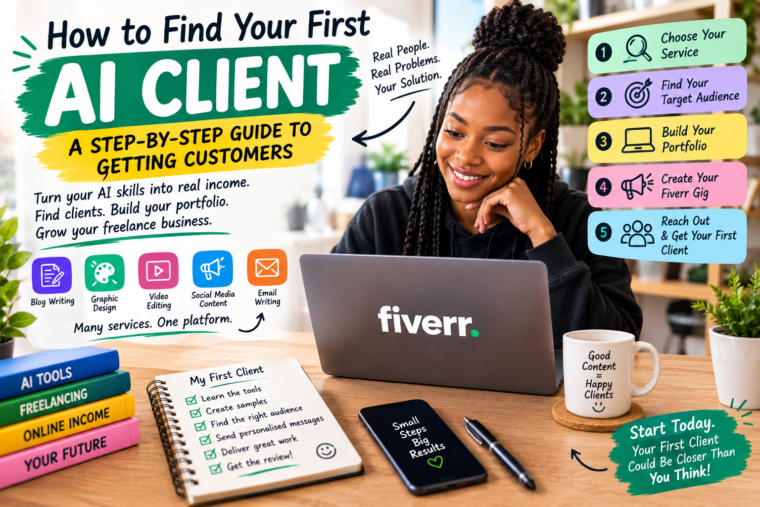
Artificial intelligence has gone from something that seemed futuristic to something people use every day.
Businesses are using AI to write content, create images, answer customer questions, analyse information, automate repetitive tasks, edit videos, and manage their social media. And while that might sound like something only programmers and technology experts can take advantage of, there is another side to the AI boom that is much more accessible.
You don’t necessarily need to build the next big AI company.
You don’t need to know how to code.
And you don’t need a huge budget to get started.
You can build a small business around using existing AI tools to help people and businesses save time, create better content, solve problems, or make their everyday work easier.
That’s the important distinction.
The opportunity isn’t simply “using AI.”
It’s learning how to use AI to provide something people are actually willing to pay for.
In this guide, we’ll look at 10 AI business ideas that beginners can realistically explore, how each one works, what you may need to get started, who might pay for the service, and how you can turn a simple idea into a real business.
What Is an AI Business?
An AI business is simply a business that uses artificial intelligence as part of its product, service, or workflow.
That can mean a lot of different things.
For example, you could:
- Use AI to write blog posts for businesses.
- Create social media content for local companies.
- Help businesses automate repetitive tasks.
- Create AI-assisted videos.
- Design graphics and marketing materials.
- Build chatbots or customer-support systems.
- Sell digital products created with AI assistance.
- Offer AI consulting or training.
- Help businesses organise and analyse information.
- Create an AI-powered content or marketing agency.
Notice something?
Most of these businesses aren’t about inventing artificial intelligence.
They’re about using AI as a tool.
Think of AI like a power tool.
Owning a drill doesn’t automatically make you a great carpenter. The value comes from knowing how to use the tool to create something useful.
The same principle applies to AI.
Why Start an AI Business as a Beginner?
There are several reasons AI businesses can be attractive to beginners.
1. You can start with existing tools
You don’t necessarily need to develop your own AI model.
There are already tools available for writing, design, video, research, automation, transcription, brainstorming, customer support, and many other tasks.
Your job is to combine those tools with your own skills and judgement.
2. You can start small
You don’t have to create a complicated company on day one.
You could start with one service, one type of customer, and even one client.
For example:
“I create 12 social media posts each month for local restaurants.”
That’s a much easier business to understand than:
“I run an AI-powered digital transformation company.”
Start simple.
3. Businesses care about results
Most business owners aren’t particularly interested in how impressive your AI tool is.
They care about questions like:
- Can you save me time?
- Can you create better content?
- Can you help me get more organised?
- Can you make my marketing easier?
- Can you reduce repetitive work?
- Can you help me communicate with customers?
- Can you help me produce more without hiring another employee?
That’s good news for beginners.
You don’t have to be the world’s greatest AI expert.
You need to be able to solve a specific problem reliably.
10 AI Business Ideas for Beginners
Let’s get into the ideas.
1. AI Content Creation Business
One of the simplest AI businesses to understand is content creation.
Businesses constantly need content.
They need:
- Blog posts
- Website copy
- Product descriptions
- Email newsletters
- Social media captions
- Articles
- Video scripts
- Advertisements
- Marketing ideas
- FAQs
- Promotional content
AI can speed up parts of the content-creation process dramatically.
But there’s an important catch.
Simply copying and pasting AI-generated text isn’t much of a business.
Customers can access AI tools themselves.
Your value comes from taking the raw material and turning it into something useful, accurate, relevant, and appropriate for the customer’s audience.
How the business works
Imagine a small fitness business owner.
They know they should post regularly, but they’re busy running the business.
You could offer a monthly content package that includes:
- 8 social media posts
- 4 longer-form posts
- Caption ideas
- Content ideas
- Promotional posts
- A simple content calendar
AI can help you brainstorm and draft the material.
You then edit, fact-check, customise, and improve it.
The client receives finished content without having to spend hours creating it themselves.
Who could be your customers?
Potential customers include:
- Restaurants
- Hair salons
- Personal trainers
- Estate agents
- Tradespeople
- Online shops
- Coaches
- Freelancers
- Small agencies
- Local service businesses
What you need
You need:
- Good writing skills
- Basic understanding of AI tools
- Research skills
- Editing ability
- Understanding of the customer’s target audience
You don’t need to be a professional author.
You simply need to produce content that is genuinely useful.
2. AI Social Media Management Business
Social media is another area where businesses often struggle.
A business owner might know they need to post on Instagram, Facebook, LinkedIn, TikTok, or another platform, but creating content consistently can become exhausting.
That’s where an AI-assisted social media service can come in.
You could help businesses plan and produce their content.
Your service could include
For example:
Monthly Social Media Package
- Content strategy
- 12–20 posts
- Captions
- Hashtag ideas
- Image concepts
- Short-form video ideas
- Content calendar
- Promotional campaigns
AI can help with brainstorming, writing first drafts, repurposing content, and generating ideas.
You still provide the human layer.
That’s what makes the service valuable.
Example
A local barber could give you:
“We’re offering 20% off haircuts for new customers this month.”
You could turn that simple piece of information into:
- An Instagram caption
- A Facebook post
- A promotional graphic
- A short video script
- A story idea
- A reminder post
- An email announcement
One piece of information becomes multiple pieces of content.
That’s where AI becomes useful.
3. AI Video Creation Business
Video has become a major part of online marketing.
But creating videos can take a lot of time.
Businesses need videos for:
- TikTok
- Instagram Reels
- YouTube Shorts
- YouTube
- Advertisements
- Product demonstrations
- Tutorials
- Promotional campaigns
You can build a business around helping companies produce this content.
What could you offer?
You might create:
Short-form video packages
For example:
- 10 short videos per month
- Scripts
- AI-assisted editing
- Captions
- Hooks
- Titles
- Thumbnail concepts
You could also take long videos and turn them into multiple short clips.
Imagine a business owner records a 30-minute interview.
Instead of creating one piece of content, you could identify several useful sections and turn them into short videos.
AI can help with transcription, identifying sections, drafting captions, generating ideas, and speeding up editing.
Who needs this?
Potential clients include:
- YouTubers
- Coaches
- Businesses
- Podcasters
- Influencers
- Consultants
- Online educators
- Real estate professionals
The key is to focus on the outcome, not simply the fact that you’re using AI.
Don’t sell:
“I use AI to make videos.”
Sell:
“I help businesses turn their existing footage into consistent short-form content.”
That’s much clearer.
4. AI Graphic Design Business
You don’t have to be a professional graphic designer to explore AI-assisted design services.
Modern design tools can help beginners create:
- Social media graphics
- Posters
- Flyers
- Presentations
- Advertisements
- YouTube thumbnails
- Marketing materials
- Simple business graphics
- Digital products
However, good design still requires human judgement.
You need to understand things like:
- Layout
- Typography
- Branding
- Colour combinations
- Visual hierarchy
- Audience
- Consistency
AI can help you create ideas quickly, but you still need to decide what actually looks professional.
A simple business model
You could specialise in one area.
For example:
“I create social media graphics for restaurants.”
Instead of trying to serve everyone, you become known for one type of work.
You might offer:
Starter Package
- 10 social media graphics
- 5 promotional designs
- 1 menu graphic
You could then expand your services as you gain experience.
Why specialising can help
Compare these two offers:
“I do graphic design.”
with:
“I create promotional social media graphics for local restaurants.”
The second one is much easier for a potential customer to understand.
5. AI-Powered Website Content Service
Building an entire website can be complicated.
But there’s another opportunity:
Helping businesses create the content that goes on their websites.
Many small businesses have websites that haven’t been updated in years.
Their pages might contain:
- Weak descriptions
- Outdated information
- Poor headlines
- Long paragraphs
- Unclear calls to action
- Missing FAQs
- Product descriptions that don’t explain the benefits
You can help improve this.
Services you could provide
You could offer:
- Homepage copy
- About page rewriting
- Service descriptions
- Product descriptions
- FAQ sections
- Blog content
- Landing-page copy
- Calls to action
AI can help you brainstorm and structure the copy.
You then edit it to match the business.
Example
A plumbing company might have a homepage that simply says:
“Welcome to our plumbing company. We provide plumbing services.”
That’s not particularly compelling.
A better version could clearly explain:
- What services they provide
- Where they operate
- Who they help
- Why customers should contact them
- What to do next
The value isn’t “AI writing.”
The value is better communication.
6. AI Automation Service
This is one of the more advanced ideas on the list, but it can become extremely useful once you understand it.
Many businesses perform repetitive tasks every week.
For example:
- Copying information between systems
- Sending routine emails
- Organising leads
- Creating reports
- Updating spreadsheets
- Sorting enquiries
- Following up with potential customers
- Scheduling tasks
- Moving information between applications
Some of these processes can be automated using AI and automation tools.
Example
Imagine a business receives enquiries through a website.
Instead of someone manually:
- Reading the enquiry
- Recording the information
- Categorising the customer
- Sending a response
- Adding the lead to a spreadsheet
you could potentially design a workflow that handles some of these steps automatically.
The exact automation depends on the business and the tools involved.
What makes this valuable?
You’re potentially helping a business reduce repetitive work.
That can be much more valuable than simply producing another piece of content.
Beginner warning
Don’t jump into complicated automation immediately.
Start by learning simple workflows.
Understand:
- Triggers
- Actions
- Data
- APIs
- Integrations
- AI prompts
- Error handling
- Human approval steps
You don’t need to become a software engineer overnight.
Learn one workflow at a time.
7. AI Chatbot Setup Service
Businesses receive questions constantly.
Customers might ask:
- What are your opening hours?
- Where are you located?
- How much does this service cost?
- Do you offer delivery?
- How can I book?
- What is your refund policy?
- What services do you provide?
A properly designed chatbot or AI assistant can help answer certain routine questions.
That creates another potential business opportunity.
Your role
Rather than building an AI model from scratch, you could help businesses:
- Organise their FAQs
- Prepare knowledge bases
- Structure chatbot conversations
- Create appropriate responses
- Test common questions
- Improve the customer experience
- Add escalation to a human when necessary
Important consideration
AI shouldn’t simply be allowed to invent answers.
Businesses need to provide accurate information and appropriate boundaries.
For example, if an AI assistant doesn’t know the answer, it should be designed to say so or direct the customer to a human.
That makes responsible setup extremely important.
8. AI-Powered Digital Products
Not every AI business needs clients.
You can also create products.
Digital products are attractive because you can potentially create something once and sell it multiple times.
Examples include:
- Ebooks
- Templates
- Checklists
- Prompt collections
- Content calendars
- Business planners
- Notion templates
- Spreadsheet templates
- Social media templates
- Printable resources
- Educational materials
AI can help with brainstorming, outlining, research assistance, and drafting.
But again, simply generating hundreds of pages with AI isn’t necessarily going to create a valuable product.
The product needs to solve a problem.
Example
Instead of creating:
“100 Random AI Prompts”
you could create something more specific:
“50 AI Prompts for Small Businesses to Create a Month of Social Media Content”
The second product targets a particular person with a particular problem.
That’s the approach you want.
Think about the buyer
Ask:
Who is this for?
What problem does it solve?
What result does it help the buyer achieve?
Why would someone pay for it instead of creating it themselves?
Those questions matter more than how much AI you used.
9. AI Research and Information Service
Businesses are constantly looking for information.
They may need help researching:
- Competitors
- Industries
- Products
- Customers
- Content ideas
- Market trends
- Potential suppliers
- Business opportunities
- Customer reviews
- Frequently asked questions
You can build a research service around helping businesses gather and organise information.
AI can make the process faster.
But human verification is extremely important.
AI-generated research can contain errors, outdated information, or misunderstood sources.
That’s why your role shouldn’t be:
“I ask AI questions.”
Instead, your role is:
“I research, organise, verify, and present useful information so you can make better-informed business decisions.”
Example service
You could create a:
Competitor Research Report
Including:
- 5 competitors
- Their main services
- Pricing information where publicly available
- Website analysis
- Content themes
- Social media observations
- Customer review themes
- Potential areas of differentiation
The final product could be delivered as a clean report.
That’s something a business owner can actually use.
10. AI Freelancing or Micro-Agency
The final idea is to combine several of the services we’ve discussed into a small AI-powered freelancing business.
Instead of selling one specific service forever, you can gradually build a broader offer.
For example:
AI Content Agency
You provide:
- Blog writing
- Social media content
- Email newsletters
- Video scripts
Or:
AI Marketing Agency
You provide:
- Social media content
- Graphics
- Short-form videos
- Email marketing
Or:
AI Automation Service
You provide:
- Workflow automation
- AI assistants
- Data organisation
- Business process improvements
You can begin as a freelancer and eventually turn the operation into an agency if demand grows.
You don’t need employees immediately.
You can start by doing the work yourself and learn what customers actually want.
How to Choose the Right AI Business Idea
Looking at ten different ideas can actually make things harder.
You might start thinking:
“Should I do content?”
“Maybe video?”
“Maybe automation?”
“Maybe I should build an AI agency?”
Take a step back.
You don’t need to choose the perfect business.
You need to choose a reasonable starting point.
Here are five questions to help.
Question 1: What are you already good at?
If you’re good at writing, content might make sense.
If you enjoy design, explore graphics.
If you enjoy technology and problem-solving, automation might interest you.
If you enjoy talking to people, sales, consulting, or training could be a better fit.
Your existing skills can give you a head start.
Question 2: What do you actually enjoy?
This sounds obvious, but it’s easy to ignore.
If you hate writing, don’t build a business that requires you to write 20 articles every week just because someone online said AI writing is profitable.
You’ll probably burn out.
Choose something you can see yourself doing repeatedly.
Question 3: Does someone have a real problem?
This is probably the most important question.
Don’t start with:
“What can AI do?”
Start with:
“What problems do people have that AI can help me solve?”
That’s a completely different way of thinking.
Question 4: Can you demonstrate the result?
If you’re offering social media management, create sample posts.
If you’re offering video editing, create sample videos.
If you’re offering website copy, create a before-and-after example.
If you’re offering automation, demonstrate a simple workflow.
A portfolio makes your offer much easier to understand.
Question 5: Can you start small?
If an idea requires thousands of pounds before you can even test it, think carefully.
A beginner-friendly business should ideally allow you to test the idea relatively cheaply.
Your first goal isn’t to build a giant company.
Your first goal is to prove:
Someone is willing to pay for this.
You Don’t Need to Be an AI Expert
This is something I think beginners need to hear.
You don’t have to know everything about artificial intelligence.
AI changes quickly.
New tools appear.
Features change.
Old tools disappear.
Trying to become an expert in everything can leave you overwhelmed.
Instead, focus on becoming useful.
Suppose you know how to use five AI tools extremely well to help restaurants create marketing content.
That can potentially be more commercially useful than knowing about 100 AI tools but not being able to solve a customer’s problem.
Learn what you need.
Then learn the next thing.
The AI Skills Worth Learning
If you’re serious about starting an AI business, don’t focus only on prompting.
There are several other skills that can make you much more valuable.
1. Communication
You need to understand what customers actually want.
2. Research
You need to know how to find and verify information.
3. Editing
AI-generated material often needs improvement.
4. Problem-solving
Customers aren’t paying you for prompts.
They’re paying you to solve problems.
5. Sales
You need to communicate your value clearly.
6. Customer service
Getting a customer is one thing.
Keeping them happy is another.
7. Basic business skills
Learn about:
- Pricing
- Invoicing
- Expenses
- Contracts
- Taxes
- Marketing
- Record keeping
The exact legal and tax requirements depend on where you live, so research the rules that apply to your situation.
How to Start Your AI Business With Almost No Experience
Here’s a simple process.
Step 1: Choose one service
Don’t start with ten.
Pick one.
For example:
AI-assisted social media content.
Step 2: Choose one customer type
Instead of targeting everyone, pick a niche.
For example:
Local restaurants.
Now your business becomes:
“I help local restaurants create consistent social media content.”
That’s much clearer.
Step 3: Learn the tools
Spend time practising.
Create fictional projects.
Experiment.
Make mistakes.
Improve.
Step 4: Build three portfolio examples
You don’t necessarily need paying clients to create examples.
You can create sample work.
For example:
Example 1: Restaurant
Example 2: Hair salon
Example 3: Fitness business
Show what you created and explain the problem you were trying to solve.
Step 5: Create a simple offer
Don’t create a complicated menu of 30 services.
Start with something easy to understand.
For example:
“I create 12 ready-to-post social media posts every month for local businesses.”
That’s straightforward.
Step 6: Find potential customers
You can explore:
- Local businesses
- Freelancing platforms
- Business communities
- Networking events
- Personal contacts
- Online communities
The important thing is to approach people professionally rather than spamming hundreds of businesses with identical messages.
Step 7: Focus on the customer’s problem
Don’t send a message that says:
“Hi, I use the latest AI technology and can revolutionise your business.”
That sounds like marketing fluff.
Instead, be specific.
For example:
“I noticed you’ve got a great range of products but haven’t posted much recently. I create ready-to-publish social media content for small businesses and put together a few sample ideas for your business.”
It’s more personal.
How Much Should You Charge?
There isn’t one universal price.
Your pricing can depend on:
- The service
- Your experience
- The complexity
- The amount of work
- The customer’s business
- The value of the outcome
- Whether it’s a one-off project
- Whether it’s ongoing work
When you’re starting, you might be tempted to charge almost nothing.
Be careful with that.
Low prices can sometimes attract customers who expect a lot of work for very little money.
Instead, think in terms of scope.
For example:
“This package includes 10 social media posts, captions, and a content calendar.”
The customer knows what they’re receiving.
As your skills and demand improve, you can adjust your pricing.
Don’t Make AI the Product
This is one of the biggest lessons in building an AI business.
Your customer doesn’t necessarily care that you used AI.
They care about the result.
Imagine two offers.
Offer A
“I use AI to generate social media posts.”
Offer B
“I create a month’s worth of ready-to-publish social media content for your business.”
Which one sounds more like a business service?
The second one.
AI is the tool behind the scenes.
The outcome is the product.
The Biggest Beginner Mistakes
Starting an AI business can be exciting, but there are some traps.
Mistake #1: Chasing every new AI tool
Every week there seems to be another “revolutionary” AI tool.
You don’t need all of them.
Learn a small collection of tools properly.
Mistake #2: Trying to serve everyone
If your business serves:
Everyone, everywhere, for everything.
your offer becomes difficult to understand.
Start narrower.
You can always expand later.
Mistake #3: Selling AI instead of solving problems
People don’t generally wake up thinking:
“I need some AI today.”
They think:
“I don’t have time to create my social media posts.”
or:
“I’m spending hours answering repetitive questions.”
or:
“My website content is terrible.”
Find the problem.
Then use AI to help solve it.
Mistake #4: Trusting AI blindly
AI can make mistakes.
It can misunderstand instructions.
It can produce inaccurate information.
It can create repetitive or generic content.
Always review important work.
Mistake #5: Building before validating
You could spend six months creating a complicated website, logo, business name, brand identity, and service packages.
Then discover nobody wants what you’re selling.
Try selling the service first.
You can improve the branding later.
A Simple 30-Day AI Business Challenge
If you’re serious about testing one of these ideas, here’s a simple month-long plan.
Week 1: Learn
Day 1: Choose one business idea.
Day 2: Choose your target customer.
Day 3: Research their biggest problems.
Day 4: Learn the main AI tools you’ll need.
Day 5: Practise your service.
Day 6: Create your first sample.
Day 7: Improve it.
Week 2: Build
Day 8: Create a second sample.
Day 9: Create a third sample.
Day 10: Build a simple portfolio.
Day 11: Create your service description.
Day 12: Create a starter package.
Day 13: Decide how you’ll deliver the work.
Day 14: Review everything.
Week 3: Find Customers
Day 15: Make a list of potential customers.
Day 16: Contact your first few prospects.
Day 17: Contact more prospects.
Day 18: Improve your message.
Day 19: Follow up with previous contacts.
Day 20: Look for opportunities on freelance platforms.
Day 21: Review what you’ve learned.
Week 4: Improve
Day 22: Continue outreach.
Day 23: Improve your portfolio.
Day 24: Improve your offer.
Day 25: Practise your sales conversation.
Day 26: Follow up.
Day 27: Ask for feedback.
Day 28: Improve your process.
Day 29: Decide what is working.
Day 30: Create your next 30-day plan.
The goal isn’t necessarily to become successful in 30 days.
The goal is to learn what works.
What If You Don’t Get a Customer?
Don’t immediately assume the business idea is terrible.
There are many reasons people don’t respond.
Maybe:
- Your offer isn’t clear.
- You’re contacting the wrong people.
- Your portfolio isn’t strong enough.
- Your message sounds generic.
- You’re targeting a crowded market.
- Your price doesn’t match the scope.
- You haven’t contacted enough relevant prospects.
- You’re not explaining the value clearly.
Treat your first attempts as research.
Ask yourself:
“What can I improve?”
rather than:
“Why is this not working?”
That mindset can make a huge difference.
How AI Businesses Can Grow
Once you’ve found something that works, you can gradually expand.
You might start with:
One service → One customer → One niche
Then move toward:
Multiple customers → Better systems → Recurring packages
Eventually:
Freelancer → Small agency → Team
You could also create digital products alongside your service business.
For example:
AI Social Media Service
↓
Social Media Templates
↓
Social Media Content Course
↓
Consulting
↓
Agency
There are many possible directions.
You don’t need to decide all of them today.
The Real Opportunity With AI
There’s a lot of hype surrounding artificial intelligence.
You will see claims about people making enormous amounts of money overnight.
It’s worth being sceptical.
Starting an AI business doesn’t guarantee success.
AI doesn’t remove the need for:
- Hard work
- Marketing
- Sales
- Communication
- Learning
- Customer service
- Persistence
- Good judgement
What AI can do is give a capable person another tool.
Someone who previously spent five hours on a task might eventually find a way to complete parts of it much faster.
That can create opportunities.
But the important question isn’t:
“How can I make money from AI?”
A better question is:
“What useful problem can I solve with AI?”
That question puts the focus where it belongs.
Frequently Asked Questions
Can a complete beginner start an AI business?
Yes. You can start by learning one specific service and practising it before attempting to build a larger business.
You don’t need to master every aspect of AI.
Do I need to know how to code?
No.
Many AI businesses can be built around writing, design, video, research, marketing, automation tools, consulting, or digital products.
Coding becomes more important for certain technical businesses, but it isn’t a requirement for every AI business.
How much money do I need to start?
It depends on the business.
Some AI services can be tested with relatively little upfront spending, especially if you already have a computer and internet connection.
However, you should account for software subscriptions, business expenses, taxes, payment processing, and other costs where applicable.
What’s the easiest AI business to start?
There isn’t one answer for everyone.
AI-assisted content creation, social media services, design, video editing, and digital products can be relatively accessible starting points.
The easiest option for you will depend on your existing skills and interests.
Can I run an AI business part-time?
Yes.
A service business can potentially be started around school, work, or other responsibilities, although your available time will determine how many customers you can realistically handle.
Can AI do all the work for me?
No.
AI can automate or accelerate parts of many workflows, but quality control, strategy, communication, research, editing, and customer relationships still matter.
Trying to remove yourself completely from the process can actually reduce the quality of the service.
Should I build my own AI tool?
Not necessarily.
If you’re a beginner, it may make more sense to first learn how to use existing tools to solve real problems.
Building software can come later if you discover a problem that genuinely requires your own product.
Is an AI business guaranteed to make money?
No.
No legitimate business model can guarantee that.
The goal is to find a problem people care about, create a useful solution, communicate your value, and improve based on customer feedback.
Final Thoughts
Starting an AI business can seem intimidating when you’re looking at everything happening in the industry.
There are new tools everywhere.
People are talking about AI agents, automation, generative video, AI employees, AI startups, and countless other developments.
It’s easy to feel like you’re already behind.
You’re not.
You don’t need to understand everything.
You don’t need to build a billion-pound company.
And you don’t need to become an AI researcher.
Start with something much smaller.
Learn one useful skill.
Choose one type of customer.
Find one problem.
Use AI to help solve it.
Create a few examples.
Put your offer in front of potential customers.
Listen to their feedback.
Improve.
Then repeat.
Your first AI business might not be the business you run five years from now.
And that’s completely fine.
The purpose of your first attempt is to learn how businesses work, how customers think, how to sell a service, how to deliver results, and how to use AI effectively.
AI is the tool.
The business comes from the problem you solve.
And for a beginner, that is probably the most important thing to remember.