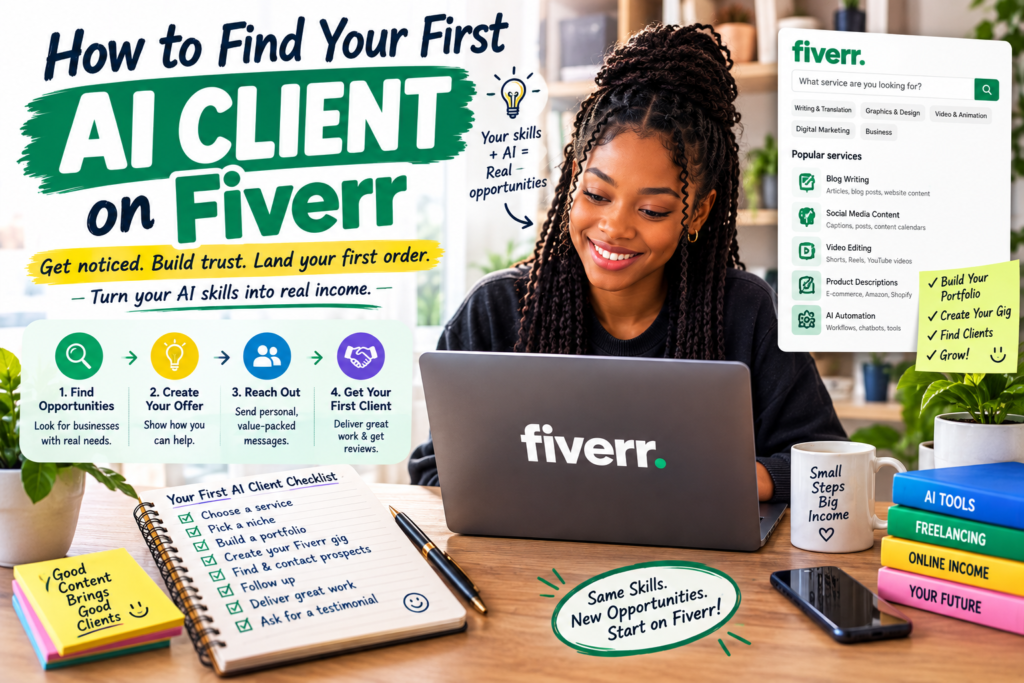
Learning how to use AI is exciting.
You can create content in minutes, generate images, write scripts, analyse information, edit videos, build ideas and automate repetitive tasks. It can feel like you’ve suddenly been handed a toolbox full of possibilities.
But eventually, there’s one question every aspiring AI freelancer has to answer:
“How do I actually find someone who will pay me?”
That’s where things get a little more difficult.
You might have learned how to use ChatGPT. You might have experimented with AI image generators. You might even have created a portfolio and set up a Fiverr profile.
But if nobody is buying, none of that matters very much.
The good news is that finding your first AI client doesn’t require a huge audience, thousands of followers or years of business experience.
You don’t even need to be an “AI expert.”
What you need is a useful skill, a specific problem you can solve and a willingness to put yourself in front of potential customers.
And here’s something worth remembering:
Your first client is usually not looking for the world’s greatest AI expert.
They’re looking for someone who can make their life a little easier.
Maybe they need social media posts.
Maybe they need blog articles.
Maybe they need videos edited.
Maybe they need product descriptions.
Maybe they’ve heard about AI but have no idea how to use it effectively.
That’s your opportunity.
In this guide, we’ll go step by step through how to find your first AI client, what services you can offer, where to look for customers, how to contact them without sounding like a spammer, how to build trust when you have no experience, and how to turn that first customer into a sustainable freelance business.
What Is an AI Client?
Before looking for clients, it’s important to understand what you’re actually selling.
An AI client isn’t necessarily somebody who wants to “buy AI.”
Most business owners aren’t sitting at their desks thinking:
“I need an artificial intelligence solution today.”
They’re thinking about problems.
For example:
“I haven’t posted on Instagram in three weeks.”
“I need ten blog posts, but I don’t have time to write them.”
“We have hours of video footage sitting on a hard drive.”
“Our website needs updating.”
“Writing product descriptions is taking forever.”
“I spend half my day answering the same customer questions.”
These are the opportunities.
AI is simply one of the tools you can use to solve them.
This is why saying:
“I sell AI services.”
isn’t always the strongest pitch.
Instead, say something like:
“I help small businesses create a month’s worth of social media content.”
Or:
“I turn long-form videos into short-form content for creators.”
Or:
“I help online stores create clear, persuasive product descriptions.”
Now the potential customer understands what you do.
Why Getting Your First Client Is So Difficult
There’s a strange psychological barrier that appears when you’re starting out.
You know you can do something.
But you haven’t done it for a paying customer yet.
You don’t have testimonials.
You don’t have dozens of reviews.
You don’t have a huge portfolio.
And you start comparing yourself with established freelancers who have been doing this for years.
It’s easy to think:
“Why would anybody choose me?”
The answer is simple:
You don’t need everyone to choose you.
You need one person to give you an opportunity.
Every successful freelancer had a first client.
Every agency had a first customer.
Every freelancer with 500 reviews once had zero.
You don’t need to compete with someone’s finished journey.
You’re building yours from the beginning.
Step 1: Choose One AI-Powered Service
Before you start searching for customers, decide what you’re actually going to sell.
This is where many beginners make their first mistake.
They create a huge list:
- AI writing
- AI images
- AI video
- AI automation
- AI consulting
- AI SEO
- AI chatbots
- AI marketing
- AI websites
- AI social media
Then they try to sell all of it.
That’s overwhelming.
Instead, choose one service to start with.
Some beginner-friendly possibilities include:
AI-Assisted Writing
- Blog posts
- Articles
- Product descriptions
- Email newsletters
- Website copy
- YouTube scripts
Social Media
- Captions
- Content calendars
- Post ideas
- Social media strategies
- Short-form content
Visual Content
- Blog graphics
- Social media images
- Thumbnails
- Advertising creatives
- Presentation graphics
Video
- YouTube Shorts
- TikTok videos
- Instagram Reels
- Podcast clips
- Captioning
Business Support
- Research
- Data organisation
- Presentations
- Document creation
- Workflow assistance
Automation
For people with more technical experience:
- AI workflows
- Chatbot systems
- Business automations
- Lead-processing systems
- Customer-support workflows
You don’t need to master everything.
One useful skill is enough to begin.
Step 2: Choose Who You Want to Help
Once you know your service, decide who needs it.
This is your target customer.
For example, if you want to create social media content, you could target:
- Restaurants
- Gyms
- Hair salons
- Clothing brands
- Estate agents
- Coaches
- Personal trainers
If you write YouTube scripts, you could target:
- YouTubers
- Faceless channels
- Educators
- Finance creators
- Gaming creators
- Commentary channels
If you create product descriptions, you could target:
- Shopify stores
- Etsy sellers
- Online retailers
- Amazon sellers
You can change your niche later.
For now, having a specific target makes everything easier.
Why Specificity Helps You Get Customers
Imagine two freelancers.
The first says:
“I provide AI content services.”
The second says:
“I help local restaurants create 30 days of social media content.”
Which one sounds easier to hire?
Probably the second.
The restaurant owner immediately understands:
This person works with businesses like mine.
That’s powerful.
You don’t have to be the best person on the internet.
You just need to look like a good fit for the particular problem you’re solving.
Step 3: Learn to Spot Business Problems
This is one of the most valuable skills you can develop.
Instead of walking around thinking:
“Who can I sell my service to?”
start asking:
“Who has a problem I can solve?”
That’s a completely different mindset.
For example, suppose you offer social media services.
You find a local restaurant.
You notice:
- Their last Instagram post was several weeks ago.
- Their food photographs look good.
- They have several promotions that aren’t being advertised online.
- Their captions are short and inconsistent.
You have identified potential problems.
You can now approach them with something useful.
You’re no longer saying:
“Please buy my service.”
You’re saying:
“I noticed something that could potentially help your business.”
That’s a much stronger position.
Step 4: Start With People You Already Know
Before sending cold messages to strangers, look around you.
You may already know potential customers.
Think about:
- Friends
- Family members
- Local business owners
- Community groups
- People who run online stores
- Content creators
- Freelancers
- Coaches
- Small business owners
Someone you know might own a business.
Someone else might know someone who does.
You don’t have to make the conversation awkward.
You could simply say:
“I’ve started offering AI-assisted content services for small businesses. If you know anyone who might need help with this, I’d really appreciate an introduction.”
That’s it.
You aren’t begging them to buy.
You’re letting them know what you do.
Step 5: Look at Local Businesses
Local businesses can be particularly interesting for beginners because they’re easy to research.
Search for businesses in your area and look at their online presence.
Check their:
- Website
- TikTok
- Google Business profile
- Blog
- YouTube channel
Look for opportunities.
Does their website have outdated content?
Are they barely posting?
Do they have great products but poor descriptions?
Do they have customer questions that aren’t answered?
Could their existing content be repurposed?
Are they missing opportunities to promote their services?
You’re not looking for businesses to criticise.
You’re looking for businesses you could genuinely help.
Step 6: Use Social Media to Find Potential Clients
Social media is one of the easiest places to discover businesses and creators.
And you don’t necessarily have to run ads.
Look for people openly discussing problems.
For example:
“I never have time to post consistently.”
That’s relevant to a social media content freelancer.
“I have loads of footage but haven’t edited it.”
Potentially relevant to a video editor.
“I need to write a newsletter every week and it’s taking forever.”
Potentially relevant to a content writer.
The trick is not to immediately jump in with:
“I can do that! Hire me!”
Instead, start a conversation.
Be helpful.
Build familiarity.
People are much more likely to trust someone they recognise.
Step 7: Use LinkedIn
LinkedIn can be especially useful if you want to work with businesses and professionals.
You can search for:
- Founders
- Small business owners
- Marketing managers
- Consultants
- Coaches
- Recruiters
- Agency owners
Don’t connect with people randomly just to increase your follower count.
Look for people who genuinely fit your target market.
Then pay attention to what they post.
What problems do they mention?
What are they working on?
What type of content do they create?
What could you potentially help with?
This gives you a much better reason to start a conversation.
Step 8: Look for Freelancers and Agencies
Here’s a strategy many beginners overlook.
Your first customer doesn’t necessarily have to be the end business.
You can work with other freelancers.
Imagine a social media agency has ten clients.
Suddenly, they get three more accounts.
They need someone to help create content.
You could become that person.
The same applies to:
- Marketing agencies
- Video agencies
- Web designers
- Copywriters
- SEO freelancers
- Social media managers
You can position yourself as someone who helps them handle extra workload.
For example:
“I help small agencies handle additional content production when their workload increases.”
That’s a useful service.
Step 9: Build a Portfolio Before Getting Paid
You might be thinking:
“How can I have a portfolio if I’ve never had a client?”
Easy.
Create one.
You can make sample projects specifically to demonstrate your ability.
Suppose you want to create social media content for restaurants.
Create a fictional restaurant.
Then produce:
- 10 captions
- 5 promotional posts
- 5 educational posts
- A weekly content calendar
- Several visual examples
Now you have something to show.
If you want to write blogs, create three sample articles.
If you want to edit videos, create sample edits.
If you want to create thumbnails, design several examples.
If you want to write YouTube scripts, create sample scripts.
You don’t need permission to demonstrate your skills.
Just be honest that they’re samples.
Step 10: Make Your Portfolio About Results
Don’t simply show people what you made.
Explain what problem the example solves.
Instead of:
“Sample Instagram post.”
Try:
“Example of a promotional Instagram post designed to help a local restaurant advertise a weekend special.”
That gives the work context.
The client can imagine using something similar for their own business.
Step 11: Create a Simple Offer
Once you know what you’re selling, package it.
For example:
Social Media Starter Package
- 10 captions
- 10 post ideas
- 5 promotional concepts
- One-week content plan
Or:
Blog Content Package
- One researched article
- SEO-friendly title
- Meta description
- FAQ section
- Social media caption
Or:
Short-Form Video Package
- Five short videos
- Captions
- Basic editing
- Vertical formatting
The customer should understand exactly what they’re buying.
Step 12: Price Your First Service Sensibly
Pricing can feel uncomfortable when you’re new.
You don’t want to charge too much.
But you also don’t want to work for practically nothing.
Start by considering:
- How long the project takes
- How difficult it is
- How much research is required
- The amount of editing involved
- How many revisions you’re offering
- The value you’re providing
Your first price doesn’t have to be your forever price.
As you improve, you can raise it.
The important thing is to avoid creating an unsustainable business where you’re working for hours for a tiny payment.
Step 13: Make the First “Yes” Easy
A potential client might hesitate to spend a large amount of money with someone they’ve never worked with.
That’s understandable.
You can reduce that risk by offering a small starter project.
For example:
Instead of:
“I’ll manage your social media for six months.”
Try:
“I’ll create your first 10 social media posts so you can see how the process works.”
Once you’ve demonstrated your value, larger projects become easier to discuss.
Step 14: Write Better Cold Messages
Cold outreach gets a bad reputation because so much of it is terrible.
You’ve probably received messages that look like:
“Hello sir/madam, we offer premium digital marketing services. Please let us know if interested.”
You immediately want to delete it.
Don’t communicate like that.
Instead, make the message about the person you’re contacting.
For example:
“Hi, I came across your business while looking at local fitness studios. I noticed you’ve got some great services but your social media content seems fairly inconsistent. I help small businesses turn their existing information and offers into ready-to-post social content. I put together a couple of ideas for your business — happy to send them over if you’d like to see them.”
Notice what’s different.
It’s:
- Personal
- Specific
- Relevant
- Short
- Low pressure
Step 15: Don’t Talk About AI Too Much
This might sound strange for an AI business.
But it’s important.
Your customer doesn’t necessarily care that you used AI.
They care about what you produced.
Imagine hiring someone to create 30 social media posts.
Would you rather hear:
“I use six different AI tools.”
or:
“I’ll give you 30 professionally edited posts ready to publish.”
The second is more useful.
AI is part of your workflow.
The result is the product.
Step 16: Give Potential Customers a Small Sample
One of the easiest ways to demonstrate your ability is to show people what you can do.
For example, if you’re approaching a restaurant, create two sample captions.
If you’re approaching a YouTuber, suggest three video ideas.
If you’re approaching an online store, rewrite one product description.
If you’re approaching a business with an outdated website, identify a few content improvements.
You don’t need to spend five hours working for free.
A small sample is enough.
Step 17: Follow Up
Sometimes people don’t respond because they’re not interested.
Sometimes they simply forgot.
Business owners are busy.
A polite follow-up can make a difference.
For example:
“Hi, just following up on my message from last week. No worries if it’s not something you’re looking for at the moment. I can still send over those sample ideas if you’d like to take a look.”
Don’t send ten follow-ups.
One or two polite reminders are usually enough.
Step 18: Keep Track of Your Outreach
Once you start contacting people, you’ll quickly lose track if you don’t organise yourself.
Create a simple spreadsheet.
You could have columns for:
| Business | Contact | Service | Date Contacted | Reply | Follow-Up | Status |
|---|---|---|---|---|---|---|
| Business A | Owner | Social media | Sept. | |||
| 3 | No reply | Sept. | ||||
| 10 | Follow-up | |||||
| Business B | Founder | Blog writing | Sept. | |||
| 4 | Interested | Sept. | ||||
| 6 | Active | |||||
| Business C | Manager | Video editing | Sept. | |||
| 5 | No | — | Closed |
You don’t need expensive CRM software.
A spreadsheet is perfectly fine when you’re starting.
Step 19: Learn From Rejection
You’re going to get rejected.
That’s part of freelancing.
Someone might say:
“We’re not interested.”
Someone else might say:
“We already have someone.”
Another person might say:
“It’s not in our budget.”
And many people won’t respond at all.
Don’t take every rejection personally.
Instead, look for patterns.
If one person says no, that’s normal.
If 100 people say no, it’s time to investigate.
Maybe:
- Your offer isn’t clear.
- You’re targeting the wrong businesses.
- Your price is wrong.
- Your portfolio isn’t convincing.
- You’re contacting the wrong person.
- The problem isn’t important enough.
Rejection can give you information.
Use it.
Step 20: Deliver Your First Project Exceptionally Well
Once somebody says yes, your job changes.
You now have to deliver.
This is where you can separate yourself from people who simply generate something with AI and send it to the customer.
Before delivering, check everything.
Look for:
- Errors
- Repetition
- Incorrect facts
- Awkward wording
- Formatting problems
- Incorrect names
- Missing information
- Brand inconsistencies
AI can help you work quickly.
But you are responsible for the final product.
Don’t Send Raw AI Output to Clients
This deserves its own section.
One of the easiest ways to damage your reputation is to copy AI output, paste it into a document and send it immediately.
AI can produce:
- Generic wording
- Incorrect information
- Repetitive sentences
- Made-up facts
- Strange formatting
- Unnatural language
Use AI as a starting point.
Then:
Review it.
Edit it.
Improve it.
Fact-check it.
Humanise it.
That’s where your value comes in.
How to Make AI-Assisted Work Feel Human
Good AI-assisted work should still sound like it was created for a real person.
Avoid stuffing your writing with phrases like:
- “In today’s fast-paced world”
- “Unlock your potential”
- “Take your business to the next level”
- “Leverage cutting-edge technology”
- “Revolutionise your workflow”
These phrases aren’t automatically bad.
They’re just incredibly common.
Instead, write like a human being.
Use:
- Real examples
- Specific details
- Simple language
- Natural transitions
- Appropriate humour when relevant
- A conversational tone
The goal isn’t to hide AI.
The goal is to produce something genuinely useful.
Step 21: Ask for a Testimonial
Once you’ve completed your first project successfully, ask your client for feedback.
You could say:
“I’m building my freelance portfolio and would really appreciate a short testimonial about your experience working with me.”
If they’re happy with your work, they may be willing to help.
Don’t write fake testimonials.
Don’t exaggerate results.
Real feedback is much more valuable.
Step 22: Ask for Referrals
Your first customer may know another potential customer.
After completing the work, you can ask:
“If you know another business that could use help with this, I’d really appreciate an introduction.”
Simple.
No pressure.
One good customer can potentially lead to another.
Step 23: Turn One Client Into Recurring Work
This is where things start becoming interesting.
Suppose you create ten social media posts for a business.
That’s a one-off project.
But perhaps they need ten more next month.
And the month after that.
Now you have the possibility of recurring revenue.
The same can happen with:
- Blog writing
- Video editing
- Social media management
- Email newsletters
- Content repurposing
- Graphic design
Instead of constantly looking for new customers, you gradually build a base of existing clients.
Step 24: Create Monthly Packages
Once you’ve proven that your service works, you can create recurring packages.
For example:
Starter
10 social media posts per month.
Growth
20 social media posts + content calendar.
Premium
30 posts + graphics + content calendar + monthly strategy.
The exact pricing depends on your service and market.
The important part is making the recurring offer easy to understand.
Step 25: Use AI to Make Your Client Work More Efficient
Once you have customers, AI becomes even more valuable.
You can use it to help with:
- Brainstorming
- Research
- Outlining
- Drafting
- Editing
- Summarising
- Content repurposing
- Organisation
- Repetitive tasks
Imagine a client gives you a 30-minute podcast.
Instead of manually starting from zero, AI can help you identify:
- Key points
- Quotes
- Topics
- Potential social posts
- Short-video ideas
- Newsletter concepts
You still review everything.
But your workflow becomes much faster.
Step 26: Build a Repeatable Client Workflow
Eventually, you want every project to follow a process.
For example:
1. Client enquiry
Understand what they need.
2. Discovery
Ask questions.
3. Brief
Write down the requirements.
4. Research
Understand the topic and audience.
5. AI-assisted production
Use your tools to speed up the work.
6. Human editing
Improve the output.
7. Quality control
Check everything.
8. Delivery
Send the finished project professionally.
9. Feedback
Ask what the client thinks.
10. Follow-up
Look for opportunities to continue working together.
A process like this makes your business much easier to manage.
How Many People Should You Contact?
There’s no magic number.
You might hear advice like:
“Send 100 messages every day!”
That’s not necessarily good advice.
If those messages are terrible, you’re simply sending 100 bad messages.
Instead, focus on relevant prospects.
You might start with:
10–20 carefully selected prospects per week.
Then improve based on what happens.
Quality beats spam.
What If Nobody Replies?
Don’t immediately give up.
Look at the numbers.
For example:
If 20 people don’t reply, that’s disappointing but not necessarily surprising.
If 100 relevant people don’t reply, investigate your approach.
Ask:
Is my message too long?
Am I contacting the right person?
Is the problem relevant?
Is my offer clear?
Does my portfolio look professional?
Am I explaining the benefit?
This turns client acquisition into a learning process rather than a guessing game.
What If Someone Says Your Price Is Too High?
Don’t automatically slash your price.
Ask yourself whether you’re explaining the value clearly.
There’s a difference between:
“I charge £150 for 30 posts.”
and:
“For £150, I’ll research your audience, create 30 tailored posts, edit them to match your brand voice and deliver them in a ready-to-publish content calendar.”
The second explains what the customer is actually receiving.
What If Someone Says They Can Use AI Themselves?
That’s a fair question.
And honestly, they can.
AI tools are becoming increasingly accessible.
Your advantage isn’t simply having access to AI.
Your advantage is knowing:
- What to ask
- What to create
- What to ignore
- What to edit
- What to verify
- How to apply it to a specific business
- How to deliver the finished result
Think about calculators.
Everyone can use a calculator.
That doesn’t mean everyone is an accountant.
The tool isn’t the skill.
Knowing how to use the tool to solve a real problem is the skill.
Where Your First AI Clients Can Come From
Don’t rely on one source.
Potential clients can come from:
Your personal network
Friends, family and acquaintances.
Local businesses
Companies in your area.
Professionals and businesses.
Creators and brands.
TikTok
Creators and small businesses.
YouTube
Creators who need content support.
Fiverr
Buyers actively searching for services.
Other freelance platforms
Different marketplaces attract different customers.
Agencies
Businesses that need help delivering client work.
Referrals
Existing customers introducing you to others.
Your own website
People searching for your service.
Your own content
Potential customers discovering your expertise.
Build an Audience as You Build Your Business
You don’t need an audience to get your first client.
But building one can help later.
For example, if you’re a freelance AI writer, you could post:
- AI writing tips
- Content examples
- Before-and-after edits
- Writing mistakes
- AI workflows
- Case studies
- Helpful tutorials
If you’re an AI video editor, share:
- Editing examples
- Before-and-after clips
- Editing tips
- Short-form strategies
- AI workflow demonstrations
Eventually, people may begin associating you with your service.
And that can lead to inbound enquiries.
Don’t Chase Viral Content
If you’re trying to find clients, you don’t necessarily need millions of views.
Imagine two scenarios.
Scenario A
100,000 people watch your video.
None of them need your service.
Scenario B
1,000 people see your content.
Twenty of them are business owners who need exactly what you offer.
Scenario B could be far more valuable.
Relevance matters more than vanity metrics.
A 30-Day Plan to Find Your First AI Client
If you’re serious about getting started, here’s a simple challenge.
Days 1-3: Choose Your Service
Pick one thing you can realistically learn and deliver.
Don’t worry about making the perfect decision.
Days 4-7: Practice
Create sample projects.
Improve your AI workflow.
Learn how to edit and fact-check your output.
Days 8-10: Choose a Target Market
Pick a specific type of customer.
For example:
Local restaurants.
Days 11-14: Create Your Portfolio
Create three to five strong samples.
Make them look professional.
Days 15-16: Create Your Offer
Decide:
- What you provide
- Who it’s for
- What they receive
- How much it costs
- How long delivery takes
Days 17-20: Find Prospects
Build a list of potential customers.
Aim for quality rather than massive numbers.
Days 21-25: Start Outreach
Send personalised messages.
Don’t copy and paste the same paragraph to everyone.
Days 26-27: Follow Up
Politely follow up with people who haven’t responded.
Days 28-30: Analyse
Look at what happened.
Which messages worked?
Which businesses responded?
What objections did people have?
What should you change?
Then do another round.
A Simple First-Client Strategy
If everything above feels overwhelming, simplify it.
Here’s the entire strategy:
Pick one service.
↓
Pick one type of customer.
↓
Create three samples.
↓
Find 20 potential clients.
↓
Research each one.
↓
Send personalised messages.
↓
Follow up.
↓
Offer a small starter project.
↓
Deliver excellent work.
↓
Ask for a testimonial.
↓
Ask for referrals.
↓
Offer recurring work.
That’s it.
You don’t need a complicated business plan to start.
Mistakes to Avoid When Searching for Your First Client
1. Waiting for Customers to Find You
If you’re completely new, you may need to actively reach out.
2. Offering Too Many Services
One strong offer is better than ten confusing ones.
3. Sending Generic Spam
People can recognise spam immediately.
4. Pretending to Be an Expert
You don’t need to lie.
Be honest about where you are.
5. Creating Fake Testimonials
Never do this.
6. Using Someone Else’s Work
Build your own portfolio.
7. Sending Raw AI Output
Always review your work.
8. Working for Free Indefinitely
Samples are useful.
Free labour isn’t a business model.
9. Giving Up After a Few Rejections
Client acquisition takes practice.
10. Chasing Every New AI Tool
You don’t need 50 tools.
You need to become good at solving a problem.
The Most Important Skill Isn’t Prompt Engineering
There’s a lot of excitement around prompting.
And learning how to communicate effectively with AI is useful.
But don’t become obsessed with creating the perfect prompt.
Your clients aren’t paying you for prompts.
They’re paying you for results.
The more valuable skills are often:
- Understanding customers
- Research
- Writing
- Design
- Editing
- Communication
- Marketing
- Problem-solving
- Reliability
AI makes these skills more powerful.
It doesn’t eliminate the need for them.
Your First Client Doesn’t Need to Be Perfect
Your first client might not be your dream customer.
That’s okay.
Your first project teaches you:
- How to communicate professionally
- How to handle deadlines
- How long work actually takes
- How to manage revisions
- What customers care about
- What customers don’t care about
- What you enjoy doing
- What you need to improve
There’s a difference between learning about freelancing and actually freelancing.
Your first customer gives you experience that tutorials can’t.
Think Long-Term
It’s tempting to think about your first client as the finish line.
It isn’t.
It’s the beginning.
One customer can become:
Customer → testimonial → referral → recurring client → case study → higher prices → more clients.
That’s how a small freelance service can gradually become a real business.
You don’t need to go from zero to £10,000 a month overnight.
You can build step by step.
Frequently Asked Questions
Can I get an AI client without experience?
Yes. Create strong sample projects, learn your chosen service thoroughly and start with smaller projects. You don’t need to pretend to have experience you don’t have.
Do I need to be an AI expert?
No. You need to be competent at the service you’re selling and understand how to use AI responsibly as part of your workflow.
Should I offer AI services for free to get clients?
You can create free samples to demonstrate your ability, but you don’t need to complete entire projects for free. A small demonstration is usually enough.
Where should I look for my first customer?
Start with your network, local businesses, social media, LinkedIn, freelance marketplaces, agencies and referrals.
How much should I charge?
There isn’t one correct price. Consider your time, complexity, experience, market and the value of the finished service. Start sustainably and adjust your pricing as you gain experience.
How long will it take to find my first client?
There is no guaranteed timeframe. Some people find their first customer quickly; others need considerably longer. Your offer, targeting, portfolio, outreach and consistency all matter.
Should I tell customers I use AI?
Be honest about your process when appropriate and follow the requirements of your client, marketplace and any relevant agreements. Don’t make misleading claims about how your work is produced.
What if clients don’t want AI-generated work?
That’s their choice. Some customers may have specific requirements about AI use. Respect those requirements and make sure your service matches what you’ve agreed to deliver.
Final Thoughts: Stop Looking for “Clients” and Start Looking for Problems
Finding your first AI client can feel intimidating.
You may feel like you don’t know enough.
You may worry about being rejected.
You may look at established freelancers and wonder how you’ll ever compete.
But here’s the thing:
You don’t need to build a huge business today.
You need to solve one problem for one person.
Maybe you help a local business create social media content.
Maybe you help a YouTuber turn long videos into Shorts.
Maybe you write blog posts for an online company.
Maybe you create product descriptions for an e-commerce store.
Maybe you automate a repetitive task that has been wasting someone’s time.
Start there.
Learn what your customer actually needs.
Use AI to make your work faster and better.
Then add your own judgment, creativity and human touch.
Don’t send raw AI output.
Don’t promise unrealistic results.
Don’t pretend to be someone you’re not.
And don’t expect customers to magically appear just because you’ve created a Fiverr account or posted a service online.
Go where potential customers are.
Talk to them.
Listen to their problems.
Show them what you can do.
Make the first step easy.
Deliver great work.
Then build from there.
Your first client might only be one small project.
But that project can give you something much more valuable than money.
It gives you proof.
Proof that someone was willing to pay for your skill.
Proof that your offer works.
Proof that you can deliver for a real customer.
And once you’ve got that first client, getting the second becomes a little less scary.
Then the third.
Then the fifth.
Eventually, you’re no longer wondering:
“Can I actually make money with AI?”
You’re asking a much better question:
“How can I build this into something bigger?”
And that’s where the real opportunity begins
Learning how to use AI is exciting.
You can create content in minutes, generate images, write scripts, analyse information, edit videos, build ideas and automate repetitive tasks. It can feel like you’ve suddenly been handed a toolbox full of possibilities.
But eventually, there’s one question every aspiring AI freelancer has to answer:
“How do I actually find someone who will pay me?”
That’s where things get a little more difficult.
You might have learned how to use ChatGPT. You might have experimented with AI image generators. You might even have created a portfolio and set up a Fiverr profile.
But if nobody is buying, none of that matters very much.
The good news is that finding your first AI client doesn’t require a huge audience, thousands of followers or years of business experience.
You don’t even need to be an “AI expert.”
What you need is a useful skill, a specific problem you can solve and a willingness to put yourself in front of potential customers.
And here’s something worth remembering:
Your first client is usually not looking for the world’s greatest AI expert.
They’re looking for someone who can make their life a little easier.
Maybe they need social media posts.
Maybe they need blog articles.
Maybe they need videos edited.
Maybe they need product descriptions.
Maybe they’ve heard about AI but have no idea how to use it effectively.
That’s your opportunity.
In this guide, we’ll go step by step through how to find your first AI client, what services you can offer, where to look for customers, how to contact them without sounding like a spammer, how to build trust when you have no experience, and how to turn that first customer into a sustainable freelance business.
What Is an AI Client?
Before looking for clients, it’s important to understand what you’re actually selling.
An AI client isn’t necessarily somebody who wants to “buy AI.”
Most business owners aren’t sitting at their desks thinking:
“I need an artificial intelligence solution today.”
They’re thinking about problems.
For example:
“I haven’t posted on Instagram in three weeks.”
“I need ten blog posts, but I don’t have time to write them.”
“We have hours of video footage sitting on a hard drive.”
“Our website needs updating.”
“Writing product descriptions is taking forever.”
“I spend half my day answering the same customer questions.”
These are the opportunities.
AI is simply one of the tools you can use to solve them.
This is why saying:
“I sell AI services.”
isn’t always the strongest pitch.
Instead, say something like:
“I help small businesses create a month’s worth of social media content.”
Or:
“I turn long-form videos into short-form content for creators.”
Or:
“I help online stores create clear, persuasive product descriptions.”
Now the potential customer understands what you do.
Why Getting Your First Client Is So Difficult
There’s a strange psychological barrier that appears when you’re starting out.
You know you can do something.
But you haven’t done it for a paying customer yet.
You don’t have testimonials.
You don’t have dozens of reviews.
You don’t have a huge portfolio.
And you start comparing yourself with established freelancers who have been doing this for years.
It’s easy to think:
“Why would anybody choose me?”
The answer is simple:
You don’t need everyone to choose you.
You need one person to give you an opportunity.
Every successful freelancer had a first client.
Every agency had a first customer.
Every freelancer with 500 reviews once had zero.
You don’t need to compete with someone’s finished journey.
You’re building yours from the beginning.
Step 1: Choose One AI-Powered Service
Before you start searching for customers, decide what you’re actually going to sell.
This is where many beginners make their first mistake.
They create a huge list:
- AI writing
- AI images
- AI video
- AI automation
- AI consulting
- AI SEO
- AI chatbots
- AI marketing
- AI websites
- AI social media
Then they try to sell all of it.
That’s overwhelming.
Instead, choose one service to start with.
Some beginner-friendly possibilities include:
AI-Assisted Writing
- Blog posts
- Articles
- Product descriptions
- Email newsletters
- Website copy
- YouTube scripts
Social Media
- Captions
- Content calendars
- Post ideas
- Social media strategies
- Short-form content
Visual Content
- Blog graphics
- Social media images
- Thumbnails
- Advertising creatives
- Presentation graphics
Video
- YouTube Shorts
- TikTok videos
- Instagram Reels
- Podcast clips
- Captioning
Business Support
- Research
- Data organisation
- Presentations
- Document creation
- Workflow assistance
Automation
For people with more technical experience:
- AI workflows
- Chatbot systems
- Business automations
- Lead-processing systems
- Customer-support workflows
You don’t need to master everything.
One useful skill is enough to begin.
Step 2: Choose Who You Want to Help
Once you know your service, decide who needs it.
This is your target customer.
For example, if you want to create social media content, you could target:
- Restaurants
- Gyms
- Hair salons
- Clothing brands
- Estate agents
- Coaches
- Personal trainers
If you write YouTube scripts, you could target:
- YouTubers
- Faceless channels
- Educators
- Finance creators
- Gaming creators
- Commentary channels
If you create product descriptions, you could target:
- Shopify stores
- Etsy sellers
- Online retailers
- Amazon sellers
You can change your niche later.
For now, having a specific target makes everything easier.
Why Specificity Helps You Get Customers
Imagine two freelancers.
The first says:
“I provide AI content services.”
The second says:
“I help local restaurants create 30 days of social media content.”
Which one sounds easier to hire?
Probably the second.
The restaurant owner immediately understands:
This person works with businesses like mine.
That’s powerful.
You don’t have to be the best person on the internet.
You just need to look like a good fit for the particular problem you’re solving.
Step 3: Learn to Spot Business Problems
This is one of the most valuable skills you can develop.
Instead of walking around thinking:
“Who can I sell my service to?”
start asking:
“Who has a problem I can solve?”
That’s a completely different mindset.
For example, suppose you offer social media services.
You find a local restaurant.
You notice:
- Their last Instagram post was several weeks ago.
- Their food photographs look good.
- They have several promotions that aren’t being advertised online.
- Their captions are short and inconsistent.
You have identified potential problems.
You can now approach them with something useful.
You’re no longer saying:
“Please buy my service.”
You’re saying:
“I noticed something that could potentially help your business.”
That’s a much stronger position.
Step 4: Start With People You Already Know
Before sending cold messages to strangers, look around you.
You may already know potential customers.
Think about:
- Friends
- Family members
- Local business owners
- Community groups
- People who run online stores
- Content creators
- Freelancers
- Coaches
- Small business owners
Someone you know might own a business.
Someone else might know someone who does.
You don’t have to make the conversation awkward.
You could simply say:
“I’ve started offering AI-assisted content services for small businesses. If you know anyone who might need help with this, I’d really appreciate an introduction.”
That’s it.
You aren’t begging them to buy.
You’re letting them know what you do.
Step 5: Look at Local Businesses
Local businesses can be particularly interesting for beginners because they’re easy to research.
Search for businesses in your area and look at their online presence.
Check their:
- Website
- TikTok
- Google Business profile
- Blog
- YouTube channel
Look for opportunities.
Does their website have outdated content?
Are they barely posting?
Do they have great products but poor descriptions?
Do they have customer questions that aren’t answered?
Could their existing content be repurposed?
Are they missing opportunities to promote their services?
You’re not looking for businesses to criticise.
You’re looking for businesses you could genuinely help.
Step 6: Use Social Media to Find Potential Clients
Social media is one of the easiest places to discover businesses and creators.
And you don’t necessarily have to run ads.
Look for people openly discussing problems.
For example:
“I never have time to post consistently.”
That’s relevant to a social media content freelancer.
“I have loads of footage but haven’t edited it.”
Potentially relevant to a video editor.
“I need to write a newsletter every week and it’s taking forever.”
Potentially relevant to a content writer.
The trick is not to immediately jump in with:
“I can do that! Hire me!”
Instead, start a conversation.
Be helpful.
Build familiarity.
People are much more likely to trust someone they recognise.
Step 7: Use LinkedIn
LinkedIn can be especially useful if you want to work with businesses and professionals.
You can search for:
- Founders
- Small business owners
- Marketing managers
- Consultants
- Coaches
- Recruiters
- Agency owners
Don’t connect with people randomly just to increase your follower count.
Look for people who genuinely fit your target market.
Then pay attention to what they post.
What problems do they mention?
What are they working on?
What type of content do they create?
What could you potentially help with?
This gives you a much better reason to start a conversation.
Step 8: Look for Freelancers and Agencies
Here’s a strategy many beginners overlook.
Your first customer doesn’t necessarily have to be the end business.
You can work with other freelancers.
Imagine a social media agency has ten clients.
Suddenly, they get three more accounts.
They need someone to help create content.
You could become that person.
The same applies to:
- Marketing agencies
- Video agencies
- Web designers
- Copywriters
- SEO freelancers
- Social media managers
You can position yourself as someone who helps them handle extra workload.
For example:
“I help small agencies handle additional content production when their workload increases.”
That’s a useful service.
Step 9: Build a Portfolio Before Getting Paid
You might be thinking:
“How can I have a portfolio if I’ve never had a client?”
Easy.
Create one.
You can make sample projects specifically to demonstrate your ability.
Suppose you want to create social media content for restaurants.
Create a fictional restaurant.
Then produce:
- 10 captions
- 5 promotional posts
- 5 educational posts
- A weekly content calendar
- Several visual examples
Now you have something to show.
If you want to write blogs, create three sample articles.
If you want to edit videos, create sample edits.
If you want to create thumbnails, design several examples.
If you want to write YouTube scripts, create sample scripts.
You don’t need permission to demonstrate your skills.
Just be honest that they’re samples.
Step 10: Make Your Portfolio About Results
Don’t simply show people what you made.
Explain what problem the example solves.
Instead of:
“Sample Instagram post.”
Try:
“Example of a promotional Instagram post designed to help a local restaurant advertise a weekend special.”
That gives the work context.
The client can imagine using something similar for their own business.
Step 11: Create a Simple Offer
Once you know what you’re selling, package it.
For example:
Social Media Starter Package
- 10 captions
- 10 post ideas
- 5 promotional concepts
- One-week content plan
Or:
Blog Content Package
- One researched article
- SEO-friendly title
- Meta description
- FAQ section
- Social media caption
Or:
Short-Form Video Package
- Five short videos
- Captions
- Basic editing
- Vertical formatting
The customer should understand exactly what they’re buying.
Step 12: Price Your First Service Sensibly
Pricing can feel uncomfortable when you’re new.
You don’t want to charge too much.
But you also don’t want to work for practically nothing.
Start by considering:
- How long the project takes
- How difficult it is
- How much research is required
- The amount of editing involved
- How many revisions you’re offering
- The value you’re providing
Your first price doesn’t have to be your forever price.
As you improve, you can raise it.
The important thing is to avoid creating an unsustainable business where you’re working for hours for a tiny payment.
Step 13: Make the First “Yes” Easy
A potential client might hesitate to spend a large amount of money with someone they’ve never worked with.
That’s understandable.
You can reduce that risk by offering a small starter project.
For example:
Instead of:
“I’ll manage your social media for six months.”
Try:
“I’ll create your first 10 social media posts so you can see how the process works.”
Once you’ve demonstrated your value, larger projects become easier to discuss.
Step 14: Write Better Cold Messages
Cold outreach gets a bad reputation because so much of it is terrible.
You’ve probably received messages that look like:
“Hello sir/madam, we offer premium digital marketing services. Please let us know if interested.”
You immediately want to delete it.
Don’t communicate like that.
Instead, make the message about the person you’re contacting.
For example:
“Hi, I came across your business while looking at local fitness studios. I noticed you’ve got some great services but your social media content seems fairly inconsistent. I help small businesses turn their existing information and offers into ready-to-post social content. I put together a couple of ideas for your business — happy to send them over if you’d like to see them.”
Notice what’s different.
It’s:
- Personal
- Specific
- Relevant
- Short
- Low pressure
Step 15: Don’t Talk About AI Too Much
This might sound strange for an AI business.
But it’s important.
Your customer doesn’t necessarily care that you used AI.
They care about what you produced.
Imagine hiring someone to create 30 social media posts.
Would you rather hear:
“I use six different AI tools.”
or:
“I’ll give you 30 professionally edited posts ready to publish.”
The second is more useful.
AI is part of your workflow.
The result is the product.
Step 16: Give Potential Customers a Small Sample
One of the easiest ways to demonstrate your ability is to show people what you can do.
For example, if you’re approaching a restaurant, create two sample captions.
If you’re approaching a YouTuber, suggest three video ideas.
If you’re approaching an online store, rewrite one product description.
If you’re approaching a business with an outdated website, identify a few content improvements.
You don’t need to spend five hours working for free.
A small sample is enough.
Step 17: Follow Up
Sometimes people don’t respond because they’re not interested.
Sometimes they simply forgot.
Business owners are busy.
A polite follow-up can make a difference.
For example:
“Hi, just following up on my message from last week. No worries if it’s not something you’re looking for at the moment. I can still send over those sample ideas if you’d like to take a look.”
Don’t send ten follow-ups.
One or two polite reminders are usually enough.
Step 18: Keep Track of Your Outreach
Once you start contacting people, you’ll quickly lose track if you don’t organise yourself.
Create a simple spreadsheet.
You could have columns for:
| Business | Contact | Service | Date Contacted | Reply | Follow-Up | Status |
|---|---|---|---|---|---|---|
| Business A | Owner | Social media | Sept. 3 | No reply | Sept. 10 | Follow-up |
| Business B | Founder | Blog writing | Sept. 4 | Interested | Sept. 6 | Active |
| Business C | Manager | Video editing | Sept. 5 | No | — | Closed |
You don’t need expensive CRM software.
A spreadsheet is perfectly fine when you’re starting.
Step 19: Learn From Rejection
You’re going to get rejected.
That’s part of freelancing.
Someone might say:
“We’re not interested.”
Someone else might say:
“We already have someone.”
Another person might say:
“It’s not in our budget.”
And many people won’t respond at all.
Don’t take every rejection personally.
Instead, look for patterns.
If one person says no, that’s normal.
If 100 people say no, it’s time to investigate.
Maybe:
- Your offer isn’t clear.
- You’re targeting the wrong businesses.
- Your price is wrong.
- Your portfolio isn’t convincing.
- You’re contacting the wrong person.
- The problem isn’t important enough.
Rejection can give you information.
Use it.
Step 20: Deliver Your First Project Exceptionally Well
Once somebody says yes, your job changes.
You now have to deliver.
This is where you can separate yourself from people who simply generate something with AI and send it to the customer.
Before delivering, check everything.
Look for:
- Errors
- Repetition
- Incorrect facts
- Awkward wording
- Formatting problems
- Incorrect names
- Missing information
- Brand inconsistencies
AI can help you work quickly.
But you are responsible for the final product.
Don’t Send Raw AI Output to Clients
This deserves its own section.
One of the easiest ways to damage your reputation is to copy AI output, paste it into a document and send it immediately.
AI can produce:
- Generic wording
- Incorrect information
- Repetitive sentences
- Made-up facts
- Strange formatting
- Unnatural language
Use AI as a starting point.
Then:
Review it.
Edit it.
Improve it.
Fact-check it.
Humanise it.
That’s where your value comes in.
How to Make AI-Assisted Work Feel Human
Good AI-assisted work should still sound like it was created for a real person.
Avoid stuffing your writing with phrases like:
- “In today’s fast-paced world”
- “Unlock your potential”
- “Take your business to the next level”
- “Leverage cutting-edge technology”
- “Revolutionise your workflow”
These phrases aren’t automatically bad.
They’re just incredibly common.
Instead, write like a human being.
Use:
- Real examples
- Specific details
- Simple language
- Natural transitions
- Appropriate humour when relevant
- A conversational tone
The goal isn’t to hide AI.
The goal is to produce something genuinely useful.
Step 21: Ask for a Testimonial
Once you’ve completed your first project successfully, ask your client for feedback.
You could say:
“I’m building my freelance portfolio and would really appreciate a short testimonial about your experience working with me.”
If they’re happy with your work, they may be willing to help.
Don’t write fake testimonials.
Don’t exaggerate results.
Real feedback is much more valuable.
Step 22: Ask for Referrals
Your first customer may know another potential customer.
After completing the work, you can ask:
“If you know another business that could use help with this, I’d really appreciate an introduction.”
Simple.
No pressure.
One good customer can potentially lead to another.
Step 23: Turn One Client Into Recurring Work
This is where things start becoming interesting.
Suppose you create ten social media posts for a business.
That’s a one-off project.
But perhaps they need ten more next month.
And the month after that.
Now you have the possibility of recurring revenue.
The same can happen with:
- Blog writing
- Video editing
- Social media management
- Email newsletters
- Content repurposing
- Graphic design
Instead of constantly looking for new customers, you gradually build a base of existing clients.
Step 24: Create Monthly Packages
Once you’ve proven that your service works, you can create recurring packages.
For example:
Starter
10 social media posts per month.
Growth
20 social media posts + content calendar.
Premium
30 posts + graphics + content calendar + monthly strategy.
The exact pricing depends on your service and market.
The important part is making the recurring offer easy to understand.
Step 25: Use AI to Make Your Client Work More Efficient
Once you have customers, AI becomes even more valuable.
You can use it to help with:
- Brainstorming
- Research
- Outlining
- Drafting
- Editing
- Summarising
- Content repurposing
- Organisation
- Repetitive tasks
Imagine a client gives you a 30-minute podcast.
Instead of manually starting from zero, AI can help you identify:
- Key points
- Quotes
- Topics
- Potential social posts
- Short-video ideas
- Newsletter concepts
You still review everything.
But your workflow becomes much faster.
Step 26: Build a Repeatable Client Workflow
Eventually, you want every project to follow a process.
For example:
1. Client enquiry
Understand what they need.
2. Discovery
Ask questions.
3. Brief
Write down the requirements.
4. Research
Understand the topic and audience.
5. AI-assisted production
Use your tools to speed up the work.
6. Human editing
Improve the output.
7. Quality control
Check everything.
8. Delivery
Send the finished project professionally.
9. Feedback
Ask what the client thinks.
10. Follow-up
Look for opportunities to continue working together.
A process like this makes your business much easier to manage.
How Many People Should You Contact?
There’s no magic number.
You might hear advice like:
“Send 100 messages every day!”
That’s not necessarily good advice.
If those messages are terrible, you’re simply sending 100 bad messages.
Instead, focus on relevant prospects.
You might start with:
10–20 carefully selected prospects per week.
Then improve based on what happens.
Quality beats spam.
What If Nobody Replies?
Don’t immediately give up.
Look at the numbers.
For example:
If 20 people don’t reply, that’s disappointing but not necessarily surprising.
If 100 relevant people don’t reply, investigate your approach.
Ask:
Is my message too long?
Am I contacting the right person?
Is the problem relevant?
Is my offer clear?
Does my portfolio look professional?
Am I explaining the benefit?
This turns client acquisition into a learning process rather than a guessing game.
What If Someone Says Your Price Is Too High?
Don’t automatically slash your price.
Ask yourself whether you’re explaining the value clearly.
There’s a difference between:
“I charge £150 for 30 posts.”
and:
“For £150, I’ll research your audience, create 30 tailored posts, edit them to match your brand voice and deliver them in a ready-to-publish content calendar.”
The second explains what the customer is actually receiving.
What If Someone Says They Can Use AI Themselves?
That’s a fair question.
And honestly, they can.
AI tools are becoming increasingly accessible.
Your advantage isn’t simply having access to AI.
Your advantage is knowing:
- What to ask
- What to create
- What to ignore
- What to edit
- What to verify
- How to apply it to a specific business
- How to deliver the finished result
Think about calculators.
Everyone can use a calculator.
That doesn’t mean everyone is an accountant.
The tool isn’t the skill.
Knowing how to use the tool to solve a real problem is the skill.
Where Your First AI Clients Can Come From
Don’t rely on one source.
Potential clients can come from:
Your personal network
Friends, family and acquaintances.
Local businesses
Companies in your area.
Professionals and businesses.
Creators and brands.
TikTok
Creators and small businesses.
YouTube
Creators who need content support.
Fiverr
Buyers actively searching for services.
Other freelance platforms
Different marketplaces attract different customers.
Agencies
Businesses that need help delivering client work.
Referrals
Existing customers introducing you to others.
Your own website
People searching for your service.
Your own content
Potential customers discovering your expertise.
Build an Audience as You Build Your Business
You don’t need an audience to get your first client.
But building one can help later.
For example, if you’re a freelance AI writer, you could post:
- AI writing tips
- Content examples
- Before-and-after edits
- Writing mistakes
- AI workflows
- Case studies
- Helpful tutorials
If you’re an AI video editor, share:
- Editing examples
- Before-and-after clips
- Editing tips
- Short-form strategies
- AI workflow demonstrations
Eventually, people may begin associating you with your service.
And that can lead to inbound enquiries.
Don’t Chase Viral Content
If you’re trying to find clients, you don’t necessarily need millions of views.
Imagine two scenarios.
Scenario A
100,000 people watch your video.
None of them need your service.
Scenario B
1,000 people see your content.
Twenty of them are business owners who need exactly what you offer.
Scenario B could be far more valuable.
Relevance matters more than vanity metrics.
A 30-Day Plan to Find Your First AI Client
If you’re serious about getting started, here’s a simple challenge.
Days 1-3: Choose Your Service
Pick one thing you can realistically learn and deliver.
Don’t worry about making the perfect decision.
Days 4-7: Practice
Create sample projects.
Improve your AI workflow.
Learn how to edit and fact-check your output.
Days 8-10: Choose a Target Market
Pick a specific type of customer.
For example:
Local restaurants.
Days 11-14: Create Your Portfolio
Create three to five strong samples.
Make them look professional.
Days 15-16: Create Your Offer
Decide:
- What you provide
- Who it’s for
- What they receive
- How much it costs
- How long delivery takes
Days 17-20: Find Prospects
Build a list of potential customers.
Aim for quality rather than massive numbers.
Days 21-25: Start Outreach
Send personalised messages.
Don’t copy and paste the same paragraph to everyone.
Days 26-27: Follow Up
Politely follow up with people who haven’t responded.
Days 28-30: Analyse
Look at what happened.
Which messages worked?
Which businesses responded?
What objections did people have?
What should you change?
Then do another round.
A Simple First-Client Strategy
If everything above feels overwhelming, simplify it.
Here’s the entire strategy:
Pick one service.
↓
Pick one type of customer.
↓
Create three samples.
↓
Find 20 potential clients.
↓
Research each one.
↓
Send personalised messages.
↓
Follow up.
↓
Offer a small starter project.
↓
Deliver excellent work.
↓
Ask for a testimonial.
↓
Ask for referrals.
↓
Offer recurring work.
That’s it.
You don’t need a complicated business plan to start.
Mistakes to Avoid When Searching for Your First Client
1. Waiting for Customers to Find You
If you’re completely new, you may need to actively reach out.
2. Offering Too Many Services
One strong offer is better than ten confusing ones.
3. Sending Generic Spam
People can recognise spam immediately.
4. Pretending to Be an Expert
You don’t need to lie.
Be honest about where you are.
5. Creating Fake Testimonials
Never do this.
6. Using Someone Else’s Work
Build your own portfolio.
7. Sending Raw AI Output
Always review your work.
8. Working for Free Indefinitely
Samples are useful.
Free labour isn’t a business model.
9. Giving Up After a Few Rejections
Client acquisition takes practice.
10. Chasing Every New AI Tool
You don’t need 50 tools.
You need to become good at solving a problem.
The Most Important Skill Isn’t Prompt Engineering
There’s a lot of excitement around prompting.
And learning how to communicate effectively with AI is useful.
But don’t become obsessed with creating the perfect prompt.
Your clients aren’t paying you for prompts.
They’re paying you for results.
The more valuable skills are often:
- Understanding customers
- Research
- Writing
- Design
- Editing
- Communication
- Marketing
- Problem-solving
- Reliability
AI makes these skills more powerful.
It doesn’t eliminate the need for them.
Your First Client Doesn’t Need to Be Perfect
Your first client might not be your dream customer.
That’s okay.
Your first project teaches you:
- How to communicate professionally
- How to handle deadlines
- How long work actually takes
- How to manage revisions
- What customers care about
- What customers don’t care about
- What you enjoy doing
- What you need to improve
There’s a difference between learning about freelancing and actually freelancing.
Your first customer gives you experience that tutorials can’t.
Think Long-Term
It’s tempting to think about your first client as the finish line.
It isn’t.
It’s the beginning.
One customer can become:
Customer → testimonial → referral → recurring client → case study → higher prices → more clients.
That’s how a small freelance service can gradually become a real business.
You don’t need to go from zero to £10,000 a month overnight.
You can build step by step.
Frequently Asked Questions
Can I get an AI client without experience?
Yes. Create strong sample projects, learn your chosen service thoroughly and start with smaller projects. You don’t need to pretend to have experience you don’t have.
Do I need to be an AI expert?
No. You need to be competent at the service you’re selling and understand how to use AI responsibly as part of your workflow.
Should I offer AI services for free to get clients?
You can create free samples to demonstrate your ability, but you don’t need to complete entire projects for free. A small demonstration is usually enough.
Where should I look for my first customer?
Start with your network, local businesses, social media, LinkedIn, freelance marketplaces, agencies and referrals.
How much should I charge?
There isn’t one correct price. Consider your time, complexity, experience, market and the value of the finished service. Start sustainably and adjust your pricing as you gain experience.
How long will it take to find my first client?
There is no guaranteed timeframe. Some people find their first customer quickly; others need considerably longer. Your offer, targeting, portfolio, outreach and consistency all matter.
Should I tell customers I use AI?
Be honest about your process when appropriate and follow the requirements of your client, marketplace and any relevant agreements. Don’t make misleading claims about how your work is produced.
What if clients don’t want AI-generated work?
That’s their choice. Some customers may have specific requirements about AI use. Respect those requirements and make sure your service matches what you’ve agreed to deliver.
Final Thoughts: Stop Looking for “Clients” and Start Looking for Problems
Finding your first AI client can feel intimidating.
You may feel like you don’t know enough.
You may worry about being rejected.
You may look at established freelancers and wonder how you’ll ever compete.
But here’s the thing:
You don’t need to build a huge business today.
You need to solve one problem for one person.
Maybe you help a local business create social media content.
Maybe you help a YouTuber turn long videos into Shorts.
Maybe you write blog posts for an online company.
Maybe you create product descriptions for an e-commerce store.
Maybe you automate a repetitive task that has been wasting someone’s time.
Start there.
Learn what your customer actually needs.
Use AI to make your work faster and better.
Then add your own judgment, creativity and human touch.
Don’t send raw AI output.
Don’t promise unrealistic results.
Don’t pretend to be someone you’re not.
And don’t expect customers to magically appear just because you’ve created a Fiverr account or posted a service online.
Go where potential customers are.
Talk to them.
Listen to their problems.
Show them what you can do.
Make the first step easy.
Deliver great work.
Then build from there.
Your first client might only be one small project.
But that project can give you something much more valuable than money.
It gives you proof.
Proof that someone was willing to pay for your skill.
Proof that your offer works.
Proof that you can deliver for a real customer.
And once you’ve got that first client, getting the second becomes a little less scary.
Then the third.
Then the fifth.
Eventually, you’re no longer wondering:
“Can I actually make money with AI?”
You’re asking a much better question:
“How can I build this into something bigger?”
And that’s where the real opportunity begins.