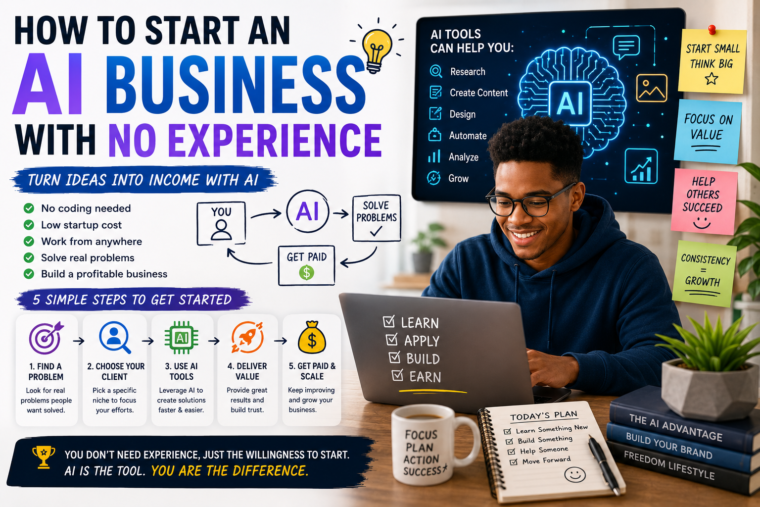
You don’t need to be a programmer, AI expert, or millionaire to start an AI business. You need a useful idea, a willingness to learn, and a problem that someone is willing to pay you to solve.
Artificial intelligence has created a strange situation.
On one hand, it feels like you need to be a technology expert to take advantage of it.
On the other hand, AI tools have become so easy to use that someone with little or no technical experience can now create things that would have required an entire team a few years ago.
You can write content.
Create images.
Edit videos.
Build websites.
Analyse information.
Automate repetitive tasks.
Create presentations.
Develop marketing materials.
Even build simple software products.
And much of this can be done without knowing how to code.
That’s why starting an AI business in 2026 is less about becoming an AI engineer and more about learning how to use AI to solve real problems.
You don’t have to build the next ChatGPT.
You don’t need to train your own AI model.
You don’t even need to understand how machine learning works under the hood.
You need to find something people struggle with and figure out how AI can help you solve it faster, cheaper, or better.
This guide will show you how to do exactly that.
Can You Really Start an AI Business With No Experience?
Yes.
But let’s clear up one misconception immediately.
“No experience” doesn’t mean “no learning required.”
You can absolutely start without previous AI-business experience.
You can start without:
- A computer science degree
- Programming experience
- A large audience
- Employees
- An office
- A huge budget
- Years of business experience
But you will need to learn.
You’ll need to understand your chosen market.
You’ll need to learn the AI tools you use.
You’ll need to communicate with customers.
You’ll need to make mistakes.
You’ll need to improve.
That’s normal.
Every successful business starts with someone who doesn’t know everything yet.
The Biggest Mistake Beginners Make
When people hear “AI business,” they often immediately think:
“What AI product can I build?”
That’s usually the wrong first question.
A better question is:
“What problem can I solve using AI?”
There’s a huge difference.
Imagine a small business owner spends five hours every week creating social media posts.
You could use AI to help them create those posts in a fraction of the time.
The business owner isn’t really buying AI.
They’re buying time saved.
Another business might receive hundreds of customer enquiries.
You could help automate some of their repetitive responses.
They’re not buying AI.
They’re buying efficiency.
An online store might need dozens of product descriptions.
They’re not buying AI.
They’re buying content production.
This is the mindset you need.
You Don’t Need to Build an AI Model
This is worth emphasising.
When someone says:
“I want to start an AI business.”
you might imagine a huge technology company with engineers developing complicated machine-learning models.
That’s one type of AI business.
It isn’t the only type.
There are plenty of businesses that use existing AI tools rather than creating AI technology from scratch.
Think of it like starting a photography business.
You don’t need to manufacture your own camera.
You use an existing camera to provide a service.
The same principle applies to AI.
The Three Main Types of AI Businesses
If you’re starting with little or no experience, three approaches are particularly worth considering.
1. AI-Powered Services
You use AI to deliver a service to clients.
Examples:
- Content creation
- Social media management
- Video editing
- Graphic design
- AI-assisted research
- Email marketing
- Virtual assistance
- Lead generation
- Website creation
This is often the easiest place for beginners to start.
2. AI Automation Services
You help businesses automate repetitive processes.
For example:
- Customer enquiries
- Data entry
- Lead management
- Email workflows
- Appointment reminders
- Document processing
This can be more technical, but you don’t necessarily need to become a programmer.
No-code and low-code tools can handle many workflows.
3. AI Digital Products
You create something once and sell it repeatedly.
Examples include:
- Templates
- Prompt libraries
- Digital guides
- AI-assisted design assets
- Online courses
- Educational resources
- Workflow systems
- Digital toolkits
This can potentially scale well, but getting customers is usually the harder part.
Which AI Business Should a Beginner Start?
If you’ve never run a business before, I’d generally recommend starting with a service.
Why?
Because services let you learn directly from customers.
You don’t need to spend months building a product before discovering that nobody wants it.
You find someone with a problem.
You offer a solution.
They pay you.
You deliver it.
Then you improve.
It’s simple.
Start With a Skill You Already Have
You might think:
“But I don’t have any skills.”
You probably do.
Maybe you’re good at:
- Writing
- Drawing
- Editing videos
- Talking to people
- Researching
- Organising
- Social media
- Photography
- Explaining things
- Teaching
- Designing
- Sales
AI can make those existing abilities more powerful.
For example:
Good at writing?
Start an AI-assisted content business.
Good at design?
Offer AI-assisted graphics.
Good at video?
Offer AI-assisted video editing.
Good with people?
Offer AI setup or training services.
Good at organisation?
Build AI-powered productivity systems.
You don’t necessarily need to become an entirely different person.
What If You Truly Have No Marketable Skills Yet?
That’s okay too.
Pick one.
Then learn it.
You could spend the next few weeks learning:
- Basic graphic design
- Video editing
- Copywriting
- Website building
- Social media marketing
- AI automation
- Data analysis
You don’t need to become world-class before starting.
You need to become useful enough to solve a specific problem.
Step 1: Choose a Problem
Before choosing your AI tool, choose your problem.
This is one of the most important decisions you’ll make.
Look around you.
What do businesses constantly complain about?
What tasks are repetitive?
What takes too long?
What do people hate doing?
What do they already pay someone to do?
Those are potential business opportunities.
Look for Boring Problems
This might sound strange.
But boring problems can be excellent businesses.
For example:
- Organising documents
- Writing product descriptions
- Creating reports
- Managing appointments
- Answering repetitive enquiries
- Turning videos into social clips
- Creating social media content
- Updating spreadsheets
These aren’t glamorous.
But if a business owner hates doing something and you’re able to make it easier, you have value.
Don’t Chase “The Next Big AI Idea”
You don’t need an idea nobody has ever thought of.
In fact, that’s often unnecessarily difficult.
Instead, look for an existing problem and find a better way to solve it.
For example:
There are already thousands of social media managers.
You could still build a social media business.
There are already thousands of web designers.
You could still build a website service.
There are already thousands of video editors.
You could still offer video editing.
Competition doesn’t automatically mean there’s no opportunity.
Step 2: Pick a Specific Customer
“Small businesses” is too broad.
Try getting more specific.
For example:
- Local restaurants
- Independent gyms
- Real estate agents
- Hair salons
- Online coaches
- YouTubers
- E-commerce stores
- Podcasters
- Local tradespeople
- Online educators
Now you have someone specific to understand.
Why Niching Down Helps
Imagine you’re a restaurant owner.
Which sounds more relevant?
“I offer AI services to businesses.”
Or:
“I help independent restaurants create a month’s worth of social media content without spending hours making it themselves.”
The second offer immediately makes sense.
The customer can see the problem you’re solving.
Step 3: Find Out What Your Customers Actually Need
Don’t guess.
Talk to people.
You could speak to:
- Business owners
- Freelancers
- Creators
- Local companies
- People in online communities
Ask questions like:
“What’s the most time-consuming part of your marketing?”
or:
“What task do you wish you could automate?”
or:
“What’s something you regularly put off because it takes too long?”
Their answers can give you business ideas.
Don’t Sell AI. Sell the Outcome.
This is one of the biggest lessons for an AI beginner.
Don’t say:
“I use AI to generate content.”
Say:
“I help small businesses publish consistent social media content without spending hours creating it themselves.”
Don’t say:
“I build AI chatbots.”
Say:
“I help businesses answer common customer questions automatically, even when nobody is available.”
The second versions focus on outcomes.
Customers care about outcomes.
Step 4: Choose Your AI Tools
Once you know what you’re selling, choose the tools.
Don’t start by subscribing to 20 different platforms.
Start with the minimum.
For example:
Content business
You might need:
- AI writing assistant
- Design tool
- Research tool
Video business
You might need:
- AI video editor
- Transcription tool
- Image/design tool
Automation business
You might need:
- AI assistant
- Automation platform
- Business apps
The exact tools will depend on the service.
Learn One Tool Properly
Don’t spend your first month jumping between AI tools.
Choose one.
Learn:
- What it does
- What it doesn’t do
- How to get better results
- How to fix mistakes
- How to integrate it into your workflow
You don’t need to know everything about AI.
You need to know how to use your chosen tools effectively.
Step 5: Build a Simple Offer
Don’t make your service complicated.
Start with one clear package.
For example:
AI Social Media Starter Package
- 12 social posts
- 12 captions
- 4 promotional graphics
- One content calendar
Or:
AI Video Repurposing Package
- One long-form video
- Five short clips
- Captions
- Vertical formatting
- Social-ready exports
The customer should understand what they’re buying within seconds.
Don’t Offer 15 Services at Once
Beginners often say:
“I can do websites, logos, social media, videos, SEO, copywriting, AI automation, chatbots…”
This can make you sound less credible.
Start with one thing.
Become good at it.
Then expand.
Step 6: Create Samples Before You Have Clients
You might be thinking:
“How am I supposed to get clients if I have no experience?”
Create sample projects.
If you want to offer social media services, create a fictional campaign.
If you want to edit videos, create sample edits.
If you want to design websites, create a fictional website.
If you want to offer product photography, create sample product visuals.
You don’t need to lie about having clients.
Simply label them as sample projects.
Build a Portfolio of 5-10 Strong Examples
You don’t need 100 examples.
Five excellent projects can be more convincing than 50 mediocre ones.
Focus on showing the type of work you want to sell.
If you’re targeting restaurants, your portfolio should look like restaurant work.
If you’re targeting YouTubers, show YouTube-related examples.
Step 7: Create a Simple Online Presence
You don’t need an expensive website.
At the beginning, you could use:
- A simple portfolio page
- A social media account
- A freelance profile
- A basic landing page
Your page should answer three questions:
Who do you help?
What do you do?
Why should someone care?
Keep it simple.
Your First Goal Isn’t £10,000
This is something social media often gets wrong.
You’ll see posts saying:
“I made £20,000 in my first month with AI!”
Maybe some people have.
But that’s not a useful target when you’re starting.
Your first goal should be:
Get one paying customer.
Then:
Get another.
Then:
Get a repeat customer.
Then:
Improve your process.
Then:
Raise your prices.
That’s how real businesses grow.
Step 8: Find Your First Customers
You don’t need thousands of followers.
Start with people who might genuinely need your service.
You can find potential clients through:
- Local businesses
- Social media
- Freelance platforms
- Networking
- Referrals
- Online communities
- Direct outreach
- Your existing contacts
Start Local
One of the easiest places to look is around you.
Think about local:
- Restaurants
- Cafés
- Gyms
- Barbers
- Salons
- Shops
- Tradespeople
- Coaches
- Small agencies
Look at their websites and social media.
Can you spot something you could improve?
That could be your opening.
Create a Sample for a Potential Client
Suppose you want to work with a local restaurant.
You could create a sample Instagram graphic using their branding and publicly available information.
Then contact them.
Instead of saying:
“I offer AI services.”
you could say:
“I noticed your recent posts don’t have a consistent visual style, so I created a sample showing what a more consistent promotional post could look like.”
Now you’re showing value.
Don’t Give Away Everything for Free
There’s a difference between demonstrating your ability and working for free.
A sample is fine.
Creating an entire month’s content for free isn’t.
Your goal is to prove that you can help.
Then get paid to do the work.
Step 9: Learn How to Sell
This might feel uncomfortable.
Especially if you’re young or you’ve never sold anything before.
But selling doesn’t have to mean being pushy.
Think of it as identifying whether there’s a good fit.
Ask:
- What problem are you dealing with?
- How much time does it take?
- What have you tried?
- What would a better solution look like?
Then explain how your service could help.
Stop Saying “I Can Do Anything”
Specific offers are easier to sell.
Instead of:
“I can help with AI.”
say:
“I can turn your weekly podcast into five short-form videos and social media clips.”
That’s concrete.
Step 10: Deliver Better Than Expected
Your first clients are extremely important.
Not because you need to keep them forever.
But because they can help you build:
- Testimonials
- Case studies
- Referrals
- Confidence
- Experience
Communicate clearly.
Meet deadlines.
Ask questions.
Review everything.
Fix mistakes quickly.
Your Reputation Matters More Than Your AI Tool
A customer doesn’t care whether you used the latest AI model.
They care whether:
- You understood the brief
- The work was good
- You met the deadline
- You communicated properly
- You solved their problem
That’s what makes people recommend you.
Step 11: Ask for Testimonials
Once you’ve completed a project successfully, ask the client for feedback.
You might ask:
“Would you mind sharing a short testimonial about your experience working with me?”
A good testimonial can become part of your portfolio.
Over time, those testimonials make it easier to win future clients.
Step 12: Turn One-Off Jobs Into Recurring Work
This is where an AI business can become much more interesting.
Suppose you create 12 social media posts for a client.
Instead of stopping there, offer:
Monthly content management.
If you edit one video, offer:
Weekly video repurposing.
If you automate one workflow, offer:
Ongoing automation support.
Recurring customers create stability.
Example: Turning a £100 Job Into a Monthly Client
Imagine you create a small batch of social media graphics for a business.
They like the work.
You could say:
“If you’d like, I can create a fresh set of branded content for you every month so you don’t have to worry about keeping up with it.”
Now you’re moving from:
One project
to:
Ongoing relationship.
That’s much more valuable.
Step 13: Improve Your Skills While You Earn
You don’t need to wait until you’re an expert.
Start small.
Then learn from each project.
If a client asks for something you don’t know how to do, don’t panic.
Research it.
Practise.
Build it.
Add it to your skill set.
Over time, your capabilities grow.
Your First Business Will Probably Be Messy
That’s normal.
Your first:
- Offer may be wrong.
- Price may be wrong.
- Portfolio may be weak.
- Outreach message may be awkward.
- Workflow may be slow.
That’s part of the process.
Don’t interpret early mistakes as proof that you’re incapable of running a business.
They’re data.
How Much Should You Charge?
There’s no universal price.
Your price depends on:
- What you’re delivering
- How much work is involved
- Your skill level
- The client’s budget
- The value of the result
- Your market
- Whether the work is one-off or recurring
As a beginner, you can start competitively without trying to be the cheapest person available.
Don’t Charge £5 Just Because AI Helped You
This is a common mistake.
Imagine you use AI to help create something in 20 minutes.
That doesn’t mean your work is worth £5.
You’re being paid for:
- Your expertise
- Your process
- Your judgement
- Your editing
- Your communication
- The finished result
AI is simply part of your toolkit.
Focus on Value, Not AI
Suppose your service helps a business save ten hours a month.
That’s potentially valuable.
If your service helps a company generate more leads, that’s valuable.
If it helps a creator publish consistently, that’s valuable.
If it helps a business respond to customers faster, that’s valuable.
The more closely your service connects to a meaningful outcome, the easier it becomes to justify charging more.
Don’t Promise Results You Can’t Guarantee
This is especially important with AI marketing businesses.
Don’t tell a client:
“My AI content will double your sales.”
unless you have legitimate evidence and a basis for making that claim.
Instead say:
“I’ll help you create a more consistent content strategy.”
Be honest.
Your reputation matters.
AI Business Idea #1: Social Media Content Service
This is one of the easiest models to understand.
You create:
- Posts
- Captions
- Graphics
- Short videos
- Content calendars
AI helps with ideation and production.
You provide the strategy and final quality control.
AI Business Idea #2: Video Repurposing
Take one long piece of content and turn it into multiple short pieces.
For example:
One podcast
↓
5 Shorts
↓
5 Reels
↓
5 TikToks
↓
Quote graphics
↓
Social captions
This can be an attractive service because businesses and creators already have content.
You’re helping them get more value from it.
AI Business Idea #3: AI-Assisted Website Creation
Small businesses often need simple websites.
You could use AI to help with:
- Website copy
- Layout ideas
- Images
- Code
- Content structure
You still need to test the website carefully.
But AI can speed up many parts of the process.
AI Business Idea #4: AI Copywriting
Businesses constantly need:
- Website copy
- Emails
- Product descriptions
- Blog posts
- Advertisements
- Social captions
AI can accelerate drafting.
Your job is to make the writing:
- Accurate
- Useful
- On-brand
- Persuasive
- Human
AI Business Idea #5: AI Design Service
Offer:
- Social media graphics
- Thumbnails
- Marketing visuals
- Presentations
- Product mockups
- Advertisements
AI can help you generate concepts and visual assets.
Your design judgement turns them into finished work.
AI Business Idea #6: AI Research Service
Some businesses need help researching:
- Competitors
- Markets
- Products
- Trends
- Customers
You can use AI to accelerate the research process.
But always verify important information.
Don’t simply copy AI-generated claims into a client report.
AI Business Idea #7: AI Virtual Assistant
You could offer businesses help with:
- Email organisation
- Research
- Meeting notes
- Data organisation
- Content preparation
- Administrative tasks
AI can make you much more efficient.
AI Business Idea #8: AI Automation Service
This can become a higher-value service.
Businesses have repetitive processes everywhere.
For example:
New enquiry
↓
Information captured
↓
Lead added to CRM
↓
Automatic email sent
↓
Follow-up reminder created
AI and automation tools can help connect these steps.
You Don’t Have to Be a Programmer
Many automation platforms use visual workflows.
You can build:
If this happens → do that.
You may eventually need technical skills for more complicated projects.
But simple automation can be learned without becoming a software engineer.
AI Business Idea #9: AI Training
Some businesses are interested in AI but don’t know where to start.
You could teach teams:
- How to use AI assistants
- How to write better prompts
- How to automate repetitive work
- How to create content
- How to use AI responsibly
This requires you to actually understand the tools you’re teaching.
Don’t pretend to be an expert after watching three tutorials.
Learn first.
AI Business Idea #10: AI Digital Products
Once you understand a particular problem, you could create:
- Templates
- Guides
- Prompt packs
- Checklists
- Workflow systems
- Training materials
For example:
“AI Content Planning Toolkit for Small Businesses”
That’s much more useful than:
“100 Random AI Prompts.”
AI Business Idea #11: AI-Assisted E-Commerce
AI can help online sellers with:
- Product descriptions
- Product images
- Marketing copy
- Customer FAQs
- Email campaigns
- Social content
You could provide these services to e-commerce businesses.
AI Business Idea #12: AI Newsletter Business
You could create a newsletter around a specific topic.
AI can help with:
- Research organisation
- Brainstorming
- Drafting
- Summarisation
But your human perspective is what makes the newsletter worth reading.
Don’t just dump AI-generated summaries into people’s inboxes.
Add:
- Opinions
- Analysis
- Examples
- Stories
- Useful recommendations
AI Business Idea #13: Build a Niche Content Agency
Instead of serving everyone, specialise.
For example:
AI-powered content for fitness businesses.
Or:
AI-assisted marketing for independent restaurants.
Or:
Video repurposing for business coaches.
A niche agency can become easier to market because your offer is specific.
AI Business Idea #14: Build a Simple AI Tool
Eventually, you might build a small software product.
For example:
- A niche content generator
- A calculator
- A document assistant
- A workflow tool
- A reporting tool
You can use no-code, low-code or development tools depending on the complexity.
But don’t start here if you’ve never built a business before.
Start with the problem.
Then validate demand.
Then build.
Validate Before You Build
This can save you months.
Before building an AI product, find potential customers.
Ask:
“Would this solve a problem for you?”
Better yet:
“Would you pay for this?”
Even better:
Get someone to actually pay.
That’s much stronger evidence than someone saying:
“That’s a cool idea.”
“Cool” Doesn’t Always Mean Profitable
AI makes it easy to build impressive things.
But impressive isn’t necessarily useful.
A tool that generates random motivational quotes might look interesting.
A tool that saves an accounting firm five hours every week could be much more valuable.
Always ask:
What problem does this solve?
The AI Business Opportunity Nobody Talks About Enough
You don’t necessarily have to sell AI products.
You can sell AI implementation.
Many businesses know AI is important.
But they don’t know:
- Which tools to use
- How to use them
- What to automate
- How to create workflows
- How to train staff
- How to integrate AI safely
That’s an opportunity.
Become the Person Who Makes AI Practical
Imagine telling a small business:
“I’ll look at your current workflow, identify three repetitive tasks, recommend AI tools, build the workflows and show your team how to use them.”
That’s much more valuable than:
“I know how to use ChatGPT.”
You’re selling implementation.
Learn to Spot AI Opportunities
When talking to a business owner, listen for phrases like:
“We spend so much time…”
“Every week we have to…”
“It’s really annoying when…”
“I wish there was a way to…”
Those statements are gold.
They reveal problems.
A Simple Formula for Finding an AI Business Idea
Use this:
Problem + Customer + AI Solution = Business Opportunity
For example:
Problem: Restaurant struggles to create social media content.
Customer: Independent restaurant.
AI solution: AI-assisted monthly content production.
Business: Social media content service.
Another:
Problem: Creator has hours of podcast footage but doesn’t have time to make clips.
Customer: Podcaster.
AI solution: AI-assisted video repurposing.
Business: Podcast clipping service.
Simple.
Your First AI Business Doesn’t Have to Be Your Final Business
This is another important mindset shift.
Your first business might teach you something.
Maybe you start with social media management.
You discover that clients actually want video.
So you specialise in video.
Then you discover that clients need automated content distribution.
So you add automation.
Your business can evolve.
Don’t feel like you need to choose the perfect idea on day one.
Use Your First Clients as Market Research
Every client conversation teaches you something.
Pay attention to:
- What they ask for
- What they complain about
- What they’re willing to pay for
- What takes you too long
- What they repeatedly need
Those observations can lead to better services.
Create Systems as You Grow
At first, you might do everything manually.
That’s okay.
But once you have a repeatable process, document it.
For example:
Client onboarding
- Receive form.
- Collect brand information.
- Create project.
- Send welcome email.
- Schedule first delivery.
Then automate what makes sense.
Your Business Shouldn’t Depend Entirely on You
At the beginning, it will.
But eventually, you want systems.
Document:
- How you onboard clients
- How you create work
- How you review it
- How you deliver
- How you handle revisions
- How you invoice
This makes it easier to grow.
The Importance of Human Quality Control
AI can make mistakes.
It can:
- Invent information
- Misinterpret instructions
- Produce inconsistent results
- Make factual errors
- Generate awkward writing
- Create strange visuals
- Produce incorrect code
That’s why your review process matters.
Before anything reaches the client:
Check it.
Don’t Let AI Make Your Business Look Cheap
One of the biggest risks is producing content that feels obviously AI-generated.
People notice.
You can avoid this by:
- Editing AI writing
- Using original ideas
- Adding personal experience
- Improving visuals
- Fact-checking
- Removing generic phrases
- Customising everything to the client
AI should help your work feel more polished—not more generic.
Develop Your Own Style
The more people use AI, the more valuable distinctive work becomes.
Develop:
- Your voice
- Your visual style
- Your process
- Your niche expertise
AI can produce generic output.
Your job is to make the final product feel like your work.
Don’t Ignore the Legal Side
If you’re using AI commercially, pay attention to:
- Tool licensing
- Commercial-use rights
- Copyright
- Trademarks
- Privacy
- Client confidentiality
- Data protection
- Usage restrictions
AI tools have different terms, and those terms can change.
Read the rules of the tools and platforms you use.
Be Especially Careful With Client Data
Don’t casually upload sensitive client information into an AI tool.
Think carefully about:
- Personal information
- Financial documents
- Private contracts
- Customer databases
- Confidential business plans
- Unreleased products
Use appropriate privacy settings and only share information when you’re confident it’s permitted and necessary.
You Don’t Need a Huge Budget
One of the attractive things about starting an AI-assisted business is that you can potentially begin with relatively little.
You may already have:
- A laptop
- An internet connection
- Free or low-cost AI tools
- Basic software
Your biggest investment may be time.
Time spent learning.
Time spent practising.
Time spent finding customers.
Time spent improving.
Don’t Spend Money Before You Have a Reason
You don’t need:
- An expensive logo
- A fancy office
- Ten AI subscriptions
- Business cards
- Expensive software
- A complicated website
Start with the basics.
Customer first.
Revenue second.
Fancy infrastructure later.
A £0 Starting Strategy
If you genuinely have no budget, you can start by learning with free tools and creating sample projects.
Week 1
Learn one AI tool.
Week 2
Choose a niche.
Week 3
Create sample work.
Week 4
Contact potential customers.
You may eventually need to pay for software as your business grows, but you don’t necessarily need a large upfront investment.
A 30-Day AI Business Challenge
Here’s a practical plan you can follow.
Days 1–3: Choose Your Skill
Pick something you can learn or already understand.
Writing.
Design.
Video.
Automation.
Research.
Social media.
Days 4-7: Choose Your Customer
Pick a specific group.
Don’t target everybody.
Days 8-10: Identify Their Problems
Research what they struggle with.
Write down at least 10 problems.
Days 11-14: Choose Your Solution
Pick one problem you can realistically solve.
Days 15-18: Learn Your Tools
Master the AI tools required to deliver your service.
Days 19-22: Build Your Portfolio
Create five strong sample projects.
Days 23-24: Create Your Offer
Make your service simple and specific.
Days 25-30: Start Outreach
Contact potential customers.
Post your work.
Ask for conversations.
Improve your pitch.
Your objective isn’t to become rich in 30 days.
It’s to start the process of becoming useful to paying customers.
What If You’re Nervous About Contacting Businesses?
Almost everyone feels uncomfortable at first.
You’re essentially saying:
“I think I can help you.”
That can feel scary.
But remember:
You’re not forcing them to buy.
You’re offering an option.
If they’re interested, have a conversation.
If they’re not, move on.
Rejection isn’t a business failure.
It’s part of selling.
Learn From Every “No”
If ten businesses say no, don’t just feel bad.
Look for patterns.
Maybe:
- Your offer isn’t clear.
- Your portfolio isn’t strong enough.
- You’re targeting the wrong people.
- Your price is too high.
- Your price is too low.
- You’re contacting the wrong person.
- You’re explaining the service badly.
Adjust.
Try again.
Don’t Compare Your Beginning to Someone Else’s Middle
This is especially important when starting an online business.
You might see someone claiming:
“I made £50,000 with AI this month.”
You don’t know:
- How long they’ve been working
- How many clients they have
- How much they spent
- Whether the claim is accurate
- What their previous experience was
Focus on your own progress.
Your first £50 is still progress.
Your first customer is still progress.
Your first testimonial is still progress.
The Long-Term Opportunity
AI is likely to continue changing how businesses operate.
That creates opportunities for people who can sit between technology and ordinary businesses.
You don’t necessarily need to be the person who invents the technology.
You can be the person who says:
“Here’s how this technology can actually help your business.”
That’s a valuable skill.
Think of Yourself as an AI Problem Solver
This mindset can completely change how you approach business.
Instead of:
“What can this AI tool do?”
ask:
“What problem could I solve with this?”
Instead of:
“What can I sell?”
ask:
“What does this customer need?”
Instead of:
“How can I make money quickly?”
ask:
“How can I create something valuable enough that people want to pay for it?”
Those questions lead to much better businesses.
Final Thoughts
Starting an AI business with no experience might sound intimidating.
But you don’t have to know everything before you begin.
You don’t need to build a complicated AI application.
You don’t need thousands of followers.
You don’t need a huge budget.
And you certainly don’t need to pretend you’re an AI expert.
Start with something much simpler.
Find a problem.
Choose a customer.
Learn a tool.
Create a solution.
Find one person who needs it.
Get paid.
Then do it again.
Your first version probably won’t be perfect.
That’s okay.
Your first offer might change.
Your first niche might change.
Your pricing might change.
Your tools might change.
That’s business.
The important thing is that you start learning from the real world rather than spending six months planning a perfect business that never launches.
The Bottom Line
You don’t need experience to start an AI business. You need a willingness to become useful.
AI has made it easier than ever for one person to produce work that once required multiple people and specialised software.
But AI itself isn’t the business.
The problem you solve is the business.
If you can help a company save time, create better content, attract customers, organise information, automate repetitive work or operate more efficiently, you have the beginnings of an AI-powered business.
Start small.
Learn as you go.
Don’t promise what you can’t deliver.
Don’t blindly trust AI.
Keep improving your skills.
And most importantly, remember that people aren’t paying you because you know how to use an AI tool.
They’re paying you because you made their life, business or work better.
That’s the real opportunity.