Artificial intelligence has gone from being something that felt futuristic to becoming a practical business tool.
Today, you don’t have to work for a huge technology company to benefit from AI. A local restaurant, hair salon, estate agent, gym, online shop, tradesperson or independent consultant can use AI to save time, create better content and handle some of the repetitive work that comes with running a business.
And that creates an interesting opportunity.
You don’t necessarily need to build your own AI software or become a computer scientist to make money from AI. Instead, you can learn how to use existing AI tools and sell the results to businesses that don’t have the time, knowledge or confidence to do it themselves.
That’s the key.
Small businesses aren’t usually looking to buy “AI.”
They’re looking for more customers, better marketing, less repetitive work and more time.
If you can help them achieve those things, AI becomes the tool you use behind the scenes.
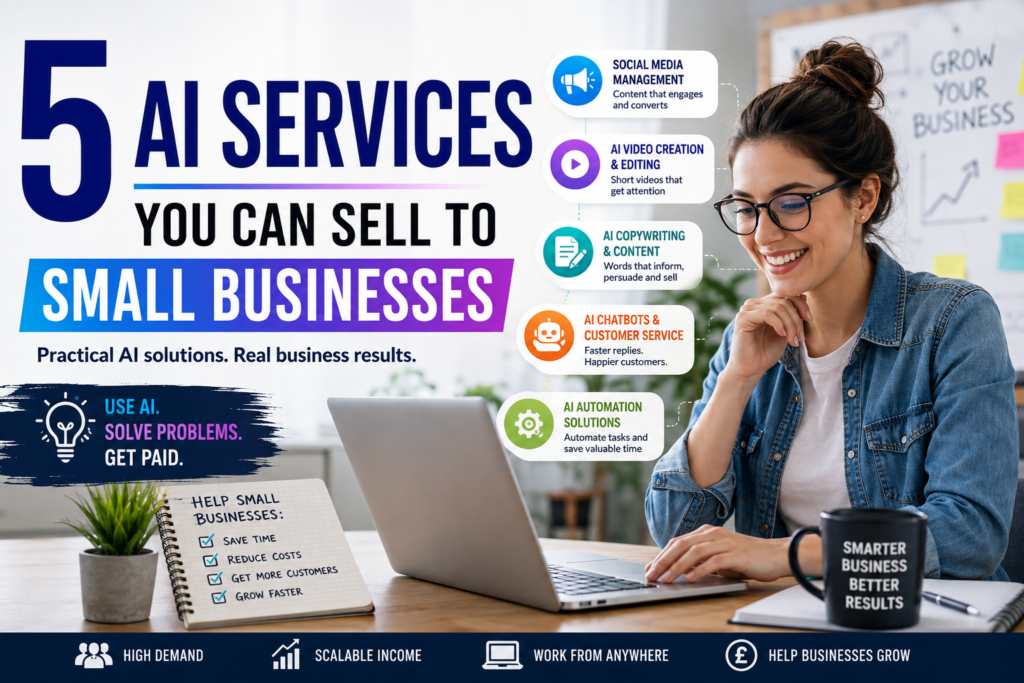
In this guide, we’ll look at five AI services you could offer to small businesses in 2026, how each service works, who might buy it, what you need to learn and how you can start turning the skill into a real business.
Why Small Businesses Are Interested in AI
Running a small business can be exhausting.
Imagine owning a local restaurant.
You have to worry about customers, suppliers, staff, bookings, reviews, social media, emails, advertising, invoices and a hundred other little tasks.
Now imagine running a plumbing company.
You’re out doing jobs most of the day, but customers are still sending enquiries, your social-media accounts need updating and your website needs attention.
Or imagine owning a beauty salon.
You know how to provide the service, but you might not have the time or expertise to create Instagram content every day.
This is where AI can become useful.
The technology can help with things such as:
- Content creation
- Research
- Writing
- Image generation
- Video editing
- Customer communication
- Data organisation
- Workflow automation
- Marketing
- Brainstorming
- Document creation
But there’s a difference between having access to AI and knowing how to use it effectively.
That’s where a service business can come in.
What Are AI Services?
An AI service is essentially a service where you use artificial intelligence to help produce a valuable result for a customer.
For example, you might offer:
“I’ll create 20 social-media posts for your business every month.”
You might use AI to help with the ideas, captions and designs.
The customer doesn’t necessarily care what tools you used.
They care that they now have 20 useful pieces of content without having to spend hours creating them.
That’s an important distinction.
You’re not really selling the AI.
You’re selling:
Time saved.
Better content.
More consistency.
Convenience.
A solution to a problem.
AI simply allows you to deliver that solution more efficiently.
1. AI-Powered Social Media Management
Social media is probably one of the easiest AI services to understand.
Almost every modern business wants some kind of social-media presence.
The problem is that actually maintaining one can be surprisingly difficult.
A business owner might think:
“I’ll post something on Instagram tomorrow.”
Tomorrow becomes next week.
Next week becomes next month.
Before long, their last post was six weeks ago.
That’s where you can help.
What Could You Offer?
You could create a monthly social-media package containing:
- Instagram posts
- Facebook posts
- TikTok ideas
- Captions
- Short-form videos
- Promotional graphics
- Content calendars
- Hashtag suggestions
- Seasonal content
- Promotional campaigns
For example, you could offer:
Basic Package
- 8 social-media posts
- 8 captions
- 4 graphics
Standard Package
- 12 social-media posts
- 12 captions
- 4 short videos
- Monthly content calendar
Premium Package
- 20+ posts
- Short-form videos
- Graphics
- Captions
- Content strategy
- Monthly performance review
The exact pricing would depend on your experience, the quality of your work and what the client needs.
The important thing is that you’re selling a package, rather than randomly charging for individual AI-generated posts.
How AI Helps
AI can help you brainstorm content ideas based on the business.
Imagine your client is a local gym.
You could ask AI to help brainstorm:
- Beginner workout tips
- Common fitness mistakes
- Exercise explanations
- Motivational posts
- Member success stories
- Promotional campaigns
- Frequently asked questions
You can then turn those ideas into actual content.
AI can also help you create first drafts of captions and organise your content calendar.
Then you add your own judgement.
That’s important.
A social-media account filled with generic AI captions will probably feel exactly that: generic.
Your job is to make the content sound like the actual business.
Who Could Buy This Service?
Almost any business that relies on social media could potentially benefit.
For example:
- Restaurants
- Cafés
- Hair salons
- Barbers
- Gyms
- Personal trainers
- Estate agents
- Clothing shops
- Beauty businesses
- Tradespeople
- Photographers
- Coaches
- Local shops
- Online businesses
A particularly good place to start is businesses that already post occasionally but clearly don’t have a consistent content strategy.
They’re already aware that social media matters.
They just aren’t keeping up with it.
2. AI Video Creation and Editing
Video has become incredibly important for businesses.
Short-form content is everywhere, and businesses increasingly want to appear on platforms such as TikTok, Instagram and YouTube.
But creating videos takes time.
Someone has to:
- Record footage
- Choose clips
- Edit them
- Add captions
- Add music
- Create hooks
- Remove unnecessary sections
- Format the video
- Export it
- Upload it
A business owner might simply not have the time.
You can turn that problem into a service.
What Could You Sell?
One simple offer could be:
“I’ll turn your existing footage into 12 engaging short-form videos every month.”
That’s much more appealing than:
“I offer AI video services.”
The first one tells the customer exactly what they’re getting.
You could create:
- TikToks
- Instagram Reels
- YouTube Shorts
- Promotional videos
- Product videos
- Educational clips
- Customer testimonials
- Before-and-after videos
- Talking-head clips
AI can assist with parts of the workflow, such as generating hooks, captions, scripts and editing suggestions.
Here’s a Simple Example
Imagine you find a local personal trainer.
They already have 30 minutes of gym footage sitting on their phone.
Instead of letting that footage sit there forever, you could turn it into:
- “3 exercises beginners should try”
- “The biggest mistake people make in the gym”
- “What I eat before training”
- “How to improve your squat”
- “A realistic beginner workout”
- “What nobody tells you about losing weight”
One recording session could potentially become multiple pieces of content.
That’s valuable.
3. AI Content and Copywriting Services
Not every business needs a social-media manager.
But almost every business needs some form of writing.
Think about how much text a business uses:
- Website pages
- Product descriptions
- Emails
- Blog posts
- Advertisements
- Social captions
- Newsletters
- Brochures
- FAQs
- Sales pages
A business owner might be excellent at running their company while being terrible at writing.
There’s nothing wrong with that.
You can offer to help.
What Could You Write?
You could specialise in a particular type of content.
For example:
Website Content
- Homepage copy
- About pages
- Service pages
- FAQ pages
- Landing pages
Marketing Content
- Facebook advertisements
- Email campaigns
- Promotional messages
- Product descriptions
Educational Content
- Blog articles
- Guides
- Tutorials
- FAQs
AI can dramatically speed up the research and drafting process.
But you shouldn’t simply take an AI response, copy it and send it to a client.
Your process should look more like:
Research → AI-assisted draft → fact-check → edit → humanise → optimise → final review
That’s how you turn AI from a shortcut into a professional tool.
The Human Element Matters
This is particularly important for writing.
AI can produce grammatically correct sentences that are completely lifeless.
Compare:
“Our company is committed to providing high-quality solutions tailored to meet your individual needs.”
with something more natural:
“Need a plumber who actually turns up when they say they will? That’s what we do.”
The second sounds like a real business talking to a real customer.
That’s the kind of value you can provide.
Your advantage isn’t simply knowing how to generate words.
It’s knowing which words should actually be used.
4. AI-Powered Customer Service and Chatbots
Here’s where things get more interesting.
Many small businesses repeatedly answer the same questions.
A restaurant might constantly receive:
“What time do you close?”
A hair salon might receive:
“How much does a haircut cost?”
A gym might receive:
“Do you offer monthly memberships?”
An estate agent might receive:
“Is this property still available?”
A business can potentially use an AI assistant or chatbot to handle some basic questions.
What Could You Offer?
You could help businesses:
- Identify repetitive customer questions
- Create FAQ databases
- Build AI-assisted responses
- Organise customer information
- Create website chat experiences
- Create internal AI assistants
- Develop response templates
The goal isn’t necessarily to replace human employees.
Instead, the goal can be to reduce repetitive work.
For example:
Customer asks a basic question → AI provides the information → complicated question gets passed to a human.
That can potentially save employees considerable time.
An Important Warning
This service requires more responsibility than simply creating social-media graphics.
You need to think about:
- Accuracy
- Privacy
- Data protection
- What information the AI is allowed to access
- When a human should take over
- What happens if the AI doesn’t know the answer
You should never promise a business that an AI chatbot will magically solve all of its customer-service problems.
The safest approach is to start with simple, well-defined tasks.
5. AI Automation Services
This is probably the most advanced service on this list, but it can also become extremely valuable.
Every business has repetitive tasks.
Some examples include:
- Copying information between systems
- Sending routine emails
- Organising enquiries
- Updating spreadsheets
- Creating reports
- Sorting documents
- Following up with leads
- Sending reminders
- Creating recurring content
Some of these workflows can potentially be automated.
Imagine This Scenario
A local business receives a new enquiry through its website.
Normally:
- Someone reads the enquiry.
- They copy the information.
- They add it to a spreadsheet.
- They send an acknowledgement email.
- They notify the appropriate employee.
- Someone follows up later.
You could potentially design a workflow where much of that happens automatically.
The process might look like:
New enquiry → information extracted → customer added to CRM → confirmation email → employee notification
Suddenly, the business owner doesn’t have to manually perform every step.
That’s a real business benefit.
Why Automation Can Be Particularly Valuable
Consider the difference between these two services.
Service A
“I’ll write you 10 AI-generated social posts.”
That’s useful.
But once you’ve delivered them, the job is finished.
Service B
“I’ll automate your lead-follow-up process so new enquiries are automatically organised and acknowledged.”
That’s potentially much more deeply connected to the business’s operations.
If your automation genuinely saves the company time or helps prevent leads from being forgotten, it can become a much more valuable service.
That’s why learning automation can be a smart long-term direction.
How Much Should You Charge?
There’s no universal price.
Your pricing should depend on things like:
- Your skill level
- The complexity of the service
- How much time it takes
- The value to the business
- The amount of ongoing support
- Your portfolio
- The type of customer you’re targeting
When you’re starting out, you might focus on getting experience and testimonials rather than immediately trying to charge premium agency rates.
For example, instead of saying:
“My service costs £2,000.”
you might first focus on:
“I’ll create a small starter package so you can see what I can do.”
Once you’ve proven your ability and understand what customers value, you can gradually increase your pricing.
Don’t Sell “AI” – Sell the Outcome
This is one of the biggest lessons to take away.
Imagine approaching a restaurant and saying:
“Hi, I provide AI services.”
The owner might think:
“Okay… and?”
Now imagine saying:
“I help local restaurants create consistent TikTok and Instagram content without the owner having to spend hours editing videos every week.”
That’s different.
You’ve identified a problem.
And you’ve presented a solution.
The technology is secondary.
How to Find Businesses That Might Need Your Service
You don’t need to immediately target massive companies.
In fact, small businesses can be a great place to start.
Look for businesses that have obvious gaps.
For example:
Social media gap
They have a great business but haven’t posted in weeks.
Video gap
They have lots of footage but aren’t creating short-form content.
Website gap
Their website looks outdated or doesn’t clearly explain their services.
Content gap
Their website has almost no useful information.
Customer-service gap
They repeatedly answer the same questions.
Automation gap
Employees spend hours doing repetitive administrative work.
These gaps give you something specific to talk about.
How to Approach Your First Client
Don’t send hundreds of identical spam messages.
Instead, personalise your outreach.
Imagine you’re contacting a local restaurant.
You could say something like:
“Hi, I came across your restaurant and noticed you’ve got some great food photos but aren’t posting many short-form videos. I put together a quick example showing how one of your existing photos/menus could be turned into a short promotional video. If you’re interested, I can create a few more for you each month.”
That’s much better than:
“Hello, I am an AI expert. Would you like my services?”
You’re demonstrating that you’ve actually looked at their business.
Build a Portfolio Before You Have Clients
One of the biggest problems beginners face is:
“How am I supposed to get clients if I have no experience?”
The answer is to create examples.
You don’t need to wait for someone to hire you.
Pick three imaginary businesses.
For example:
- A fictional restaurant
- A fictional gym
- A fictional clothing brand
Then create:
- Social-media posts
- Videos
- Website copy
- Advertisements
- AI-assisted workflows
Now you have something to show potential clients.
Just make it clear that these are sample projects rather than pretending they’re real clients.
Choose a Niche
You can offer your services to everyone.
But there’s an advantage to specialising.
Instead of:
“I create AI content for businesses.”
Try:
“I create short-form video content for fitness businesses.”
Or:
“I help local restaurants manage their social media.”
Or:
“I build AI-powered workflows for estate agents.”
A niche allows you to understand the customer’s problems more deeply.
It also makes your marketing easier.
Combine Services
You don’t necessarily have to sell one service forever.
In fact, combining related services can create a much stronger offer.
For example:
Social Media Package
- 12 social posts
- 8 graphics
- 4 short videos
- Captions
- Content calendar
Or:
Small Business AI Package
- AI workflow audit
- Customer-service templates
- Social-media system
- Content creation
- Basic automation
Now you’re not simply selling a collection of AI-generated outputs.
You’re helping the business build a system.
Five Services at a Glance
| Service | Beginner Friendly? | Potential Value | Main Skills |
|---|---|---|---|
| AI Social Media | ⭐⭐⭐⭐⭐ | High | Content + marketing |
| AI Video Editing | ⭐⭐⭐⭐ | High | Editing + storytelling |
| AI Copywriting | ⭐⭐⭐⭐⭐ | Medium–High | Writing + research |
| AI Chatbots | ⭐⭐⭐ | High | AI + customer service |
| AI Automation | ⭐⭐ | Very High | Automation + business processes |
If you’re completely new, social media, video or writing are probably easier places to begin.
If you’re more technically minded, chatbots and automation could be worth exploring.
The Biggest Mistake Beginners Make
There’s a temptation to learn every AI tool available.
You might spend weeks jumping between:
- ChatGPT
- Claude
- Gemini
- Image generators
- Video generators
- Voice generators
- Automation platforms
- Coding assistants
- Design tools
And at the end of it, you still haven’t made anything.
Don’t do that.
Pick one problem.
Then learn enough tools to solve it.
For example:
“I want to help local businesses create short-form content.”
Great.
Learn:
- One AI assistant
- One video editor
- One design tool
Then practise.
That’s enough to start.
AI Is the Tool – Your Skill Is the Business
This is perhaps the most important idea in the entire article.
AI is becoming easier to access.
That means simply knowing how to use an AI chatbot isn’t likely to be a massive competitive advantage forever.
Your real advantage comes from knowing how to combine AI with another skill.
For example:
AI + marketing
AI + video editing
AI + copywriting
AI + web design
AI + automation
AI + customer service
The combination is much more powerful.
A Simple 30-Day Plan to Get Started
If you want to turn one of these ideas into an actual service, don’t overcomplicate it.
Week 1: Pick Your Service
Choose one.
Not five.
For example:
AI-powered social-media content.
Learn the fundamentals.
Week 2: Practise
Create sample work.
Aim for around 5–10 strong examples.
Try different industries.
Week 3: Build Your Offer
Decide:
- Who you help
- What you provide
- How often you provide it
- How customers contact you
- What your starter package includes
Keep it simple.
Week 4: Start Outreach
Find businesses that could genuinely benefit.
Contact a small number of potential clients each day.
Personalise your messages.
Show examples.
Ask questions.
And don’t be discouraged if people say no.
You’re learning sales at the same time you’re learning the service.
What Makes an AI Service Worth Paying For?
Before you offer anything, ask yourself five questions:
1. Does it solve a real problem?
If the answer is no, rethink the service.
2. Does it save the customer time?
Time is valuable.
3. Could it help the customer make or save money?
Even better.
4. Can I consistently deliver good quality?
Don’t sell something you can’t reliably produce.
5. Would a business owner rather pay me than do it themselves?
This is the big one.
If the answer is yes, you may have a viable service.
The Future of AI Services
AI isn’t going away.
But the services people pay for will continue to change.
Some tasks that currently require significant manual work may eventually become automated.
That’s not necessarily bad news.
It means you should focus on becoming the person who knows how to use the technology to achieve a business outcome, rather than someone who performs one tiny task manually.
For example, don’t just learn:
“How to write AI captions.”
Learn:
“How to create a social-media content system for a local business.”
Don’t just learn:
“How to generate AI images.”
Learn:
“How to create a complete visual marketing campaign.”
Don’t just learn:
“How to automate an email.”
Learn:
“How to identify and automate repetitive business processes.”
The broader skill is much more valuable.
Final Thoughts
There are plenty of ways to make money with AI in 2026, but you don’t need to chase every opportunity.
Start small.
Pick one service.
Pick one type of customer.
Learn what they actually need.
Use AI to make your work faster and more efficient.
And most importantly, deliver something that is genuinely useful.
The businesses that pay you aren’t going to care whether you used the latest AI model or spent three hours writing the perfect prompt.
They’re going to care about whether you helped them get more done, attract more customers, save time or make their business easier to run.
That’s the real opportunity.
Don’t sell AI. Sell the result AI helps you create.