You don’t need to be a programmer to make money with AI. In fact, some of the easiest AI side hustles to start are based on skills like writing, design, video editing, research and communication.
For a long time, whenever people talked about artificial intelligence, the conversation seemed to revolve around programmers.
Machine learning engineers.
Software developers.
Data scientists.
People staring at lines of code that looked completely incomprehensible to everyone else.
And if you weren’t technical, it was easy to think:
“AI probably isn’t for me.”
But things have changed.
Modern AI tools have made it possible for ordinary people to use incredibly powerful technology without understanding how it works behind the scenes.
You can generate ideas, create graphics, edit videos, write content, research topics, organise information and automate repetitive tasks without becoming a software engineer.
That opens up some interesting opportunities for people looking for a side hustle.
And no, we’re not talking about pressing a button and magically becoming rich.
You still need to learn a skill, find customers and provide something people actually value.
But AI can dramatically lower the amount of time and effort needed to get started.
In this guide, we’ll look at seven AI side hustles that don’t require coding, how they work, what you need to get started, how AI fits into each one and how you can turn a small side hustle into something bigger over time.
First, What Exactly Is an AI Side Hustle?
An AI side hustle is simply a way of making money where artificial intelligence helps you produce a product or service.
AI doesn’t necessarily have to be the thing you’re selling.
It can simply be the tool that helps you do the work faster.
For example, imagine you offer social media content creation.
Your customer doesn’t necessarily care that you use AI.
They care that you can give them:
- Better content
- Consistent posts
- Professional graphics
- Engaging captions
- Time savings
AI is simply part of the process you use to deliver those results.
That’s an important distinction.
Don’t sell the technology. Sell the outcome.
Do You Really Need Coding Skills?
No.
There are plenty of AI-powered services that can be started without writing code.
You can use existing platforms and tools to perform tasks that previously required specialised technical knowledge.
Of course, learning some basic technical skills can eventually be useful.
But you don’t need to spend six months learning Python before you can earn your first pound.
Instead, focus on learning:
- One useful skill.
- One or two AI tools.
- One specific type of customer.
- One problem you can solve.
That’s enough to begin.
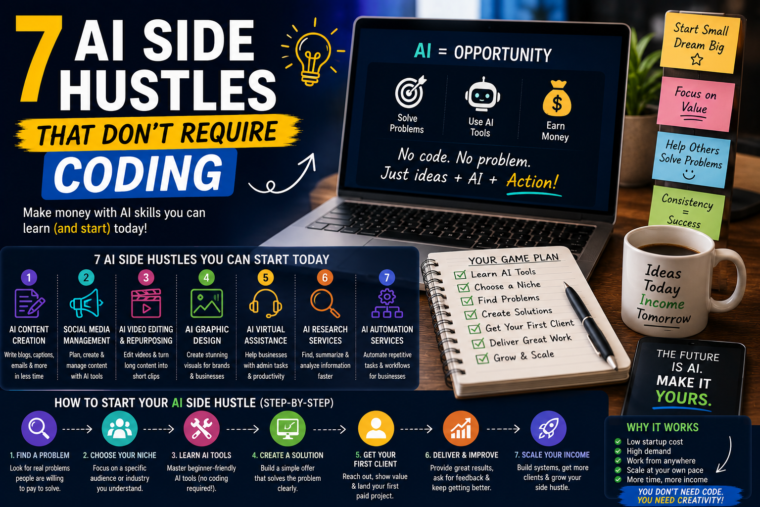
1. AI-Powered Content Creation
One of the simplest AI side hustles to understand is content creation.
Businesses need content constantly.
Think about how much a typical business might need:
- Blog posts
- Social media captions
- Emails
- Product descriptions
- Website copy
- Newsletters
- Promotional content
- Video scripts
The problem is that creating all of this takes time.
That’s where you can help.
What You Can Offer
You could create a simple service around one type of content.
For example:
“I create 12 social media posts every month for small businesses.”
Or:
“I write SEO-friendly blog content for local businesses.”
Or:
“I create product descriptions for online stores.”
The more specific your offer, the easier it is for potential customers to understand what you’re selling.
How AI Helps
AI can help you:
- Brainstorm topics
- Create outlines
- Generate first drafts
- Rewrite content
- Suggest headlines
- Adapt content for different platforms
- Repurpose existing material
- Create content calendars
But don’t simply copy and paste whatever AI produces.
That’s where many beginners go wrong.
AI-generated content can sound generic, repetitive or inaccurate.
Your job is to turn the raw output into something genuinely useful.
Example Workflow
Imagine a local gym wants 12 social media posts.
You could:
Step 1: Research the gym and its audience.
Step 2: Create a content strategy.
Step 3: Use AI to brainstorm post ideas.
Step 4: Create drafts.
Step 5: Add your own ideas and expertise.
Step 6: Create graphics.
Step 7: Edit everything.
Step 8: Deliver the finished content.
AI makes the process faster.
You’re still responsible for the quality.
2. AI Social Media Management
If you’re comfortable with social media, this could be an excellent side hustle.
Small businesses know they should be posting.
The problem?
They don’t have time.
A restaurant owner might be busy running the restaurant.
A barber is busy cutting hair.
A personal trainer is busy training clients.
A plumber is out doing jobs.
They don’t necessarily want to spend their evening creating Instagram posts.
You can take that responsibility off their hands.
What Could You Offer?
A basic package might include:
- Social media strategy
- Content ideas
- Captions
- Graphics
- Short videos
- Content calendar
- Hashtag research
- Monthly reporting
AI can help speed up many of these tasks.
Choose a Niche
Don’t start by saying:
“I manage social media for everyone.”
Choose a group.
For example:
- Restaurants
- Gyms
- Salons
- Barbers
- Estate agents
- Coaches
- Local shops
- Tradespeople
This makes your marketing much easier.
Instead of being another generic social media manager, you become:
“The person who helps local restaurants stay consistent on social media.”
That’s much clearer.
3. AI Video Editing and Content Repurposing
Video has become incredibly important online.
But editing takes time.
That’s why AI-assisted video editing can make a great side hustle.
You don’t need to become a Hollywood editor.
You can start with simple content.
What Can You Offer?
For example:
“I’ll turn your long-form videos into short-form clips for TikTok, Instagram and YouTube Shorts.”
This is particularly useful for:
- Podcasters
- YouTubers
- Coaches
- Businesses
- Online educators
- Consultants
They already have content.
They just don’t have time to repurpose it.
Here’s the Opportunity
Imagine someone records a one-hour podcast.
That one recording could contain:
- 5 useful tips
- 3 funny moments
- 4 controversial opinions
- 2 interesting stories
Instead of publishing one video and moving on, you could turn it into multiple pieces of content.
AI can help identify sections, generate transcripts and speed up editing.
You then add the human judgement needed to make the clips actually interesting.
Your Service Could Look Like This
Monthly Video Repurposing Package
- 4 long videos processed
- 20 short-form clips
- Captions
- Vertical formatting
- Basic editing
- Social-ready files
You could charge for the package rather than charging by the hour.
4. AI Graphic Design
You don’t need to be a professional illustrator to start offering simple design services.
AI and beginner-friendly design platforms have made visual content much more accessible.
Businesses need graphics for:
- YouTube
- Websites
- Advertisements
- Flyers
- Presentations
- Promotions
If you have an eye for design, there’s an opportunity here.
What You Could Sell
You might offer:
Social Media Graphics
Create branded posts for businesses.
YouTube Thumbnails
Help creators make more visually appealing thumbnails.
Promotional Materials
Design posters and digital advertisements.
Presentation Design
Turn boring presentations into something more professional.
Marketing Graphics
Create banners, announcements and promotional visuals.
Where AI Comes In
AI can help you:
- Generate visual concepts
- Create image variations
- Remove backgrounds
- Edit images
- Generate certain visual elements
- Brainstorm layouts
- Produce draft designs
But the final product should still receive human attention.
Design isn’t simply:
“Generate image.”
It’s about understanding what the image needs to accomplish.
5. AI-Powered Virtual Assistance
Virtual assistance is another side hustle that can be enhanced dramatically by AI.
A virtual assistant might help a business with:
- Email management
- Research
- Scheduling
- Data entry
- Document organisation
- Customer communication
- Meeting notes
- Content preparation
AI can reduce the amount of time these tasks take.
Imagine This
A client sends you 20 customer enquiries.
Instead of manually organising every message, you could use AI to help categorise them.
For example:
Sales enquiry
Support request
General question
Urgent issue
Follow-up required
You can then handle each category appropriately.
AI Doesn’t Replace the Assistant
This is important.
AI can make you faster.
It doesn’t necessarily remove the need for a human.
Someone still needs to:
- Review information
- Make decisions
- Communicate with clients
- Handle unusual situations
- Check for errors
That’s where your value comes from.
6. AI Research and Data Services
Research might not sound exciting.
But businesses constantly need information.
They want to understand:
- Competitors
- Customers
- Markets
- Products
- Trends
- Industry developments
If you’re good at finding and organising information, you can turn that into a service.
What Could You Offer?
For example:
“I create monthly competitor research reports for small businesses.”
Or:
“I research potential customers and create lead lists for B2B companies.”
Or:
“I research industry trends and turn them into easy-to-read reports.”
AI Can Speed Up the Research Process
You can use AI to help:
- Organise research
- Summarise documents
- Identify themes
- Generate research questions
- Compare information
- Structure reports
But there’s a major warning here.
Don’t trust AI blindly with facts.
AI can make mistakes.
If you’re providing research to a paying customer, verify important claims using reliable sources.
Your reputation is on the line.
7. AI Automation Services
This is probably the most advanced side hustle on the list, but it’s also one of the most interesting.
Businesses have repetitive tasks everywhere.
For example:
Customer submits a form.
↓
Information gets added to a spreadsheet.
↓
Confirmation email is sent.
↓
Follow-up reminder is created.
↓
Sales team receives notification.
A business might currently perform those steps manually.
You can help automate them.
Do You Need to Code?
Not necessarily.
No-code and low-code automation platforms allow people to connect different applications using visual workflows.
You can create rules like:
When X happens → do Y.
For example:
New customer enquiry → add customer to CRM → send confirmation email → create follow-up task.
AI can then be added to certain steps.
Example AI Automation Service
Imagine you work with a small estate agency.
Every time someone submits an enquiry, the system could:
- Capture their information.
- Categorise the enquiry.
- Create a record.
- Draft a personalised response.
- Notify the appropriate team member.
- Create a follow-up reminder.
You aren’t necessarily building complicated software.
You’re connecting existing tools into a useful workflow.
Which Side Hustle Should You Choose?
The answer depends on what you’re naturally good at.
Here’s a simple guide.
| If You’re Good At… | Consider… |
|---|---|
| Writing | AI content creation |
| Social media | AI social media management |
| Video | AI video editing |
| Design | AI graphic design |
| Organisation | AI virtual assistance |
| Research | AI research services |
| Problem-solving | AI automation |
You don’t have to choose something completely unfamiliar.
Start with an ability you already have.
What If You Don’t Have Any Skills?
This is a common concern.
Maybe you’re thinking:
“I’m not a writer.”
“I’m not a designer.”
“I’m not a video editor.”
That’s okay.
Pick one.
Learn it.
You don’t need to become the world’s best writer.
You need to become useful enough to solve a specific problem.
For example, you could spend several weeks learning basic short-form video editing.
Then practise by creating sample clips.
Then create a portfolio.
Then start contacting potential clients.
The Best AI Side Hustle Is Usually Boring
This might be surprising.
People often search for:
“The secret AI side hustle nobody knows about.”
But businesses rarely pay for secrets.
They pay for useful services.
A boring service like:
“I’ll turn your weekly videos into short clips.”
can be far more profitable than a complicated AI idea nobody understands.
Don’t Build an AI App First
If you’re new to business, resist the urge to build an app immediately.
Building a product can take months.
And you could eventually discover that nobody wants it.
Services are often easier to validate.
Find a customer.
Solve their problem.
Get paid.
Then repeat.
If you notice the same problem appearing repeatedly, you can eventually turn your process into a product.
How to Find Your First Customer
This is the part people often skip.
Knowing how to use AI is not enough.
You need customers.
Start looking for businesses that already have the problem you’re trying to solve.
Look at Local Businesses
Search for:
- Restaurants
- Salons
- Gyms
- Shops
- Estate agents
- Coaches
- Tradespeople
Look at their online presence.
Ask yourself:
“What could I improve?”
Then create a small sample.
Don’t Spam Hundreds of Businesses
You might see advice telling you to send 500 messages a day.
That’s rarely a good strategy for a beginner.
Instead, contact fewer businesses with better messages.
Show that you’ve actually looked at their business.
For example:
“I noticed you haven’t posted a new video in a few weeks. I took one of your existing videos and created a short-form sample to show what it could look like.”
That’s far more compelling than:
“Hello, I provide AI services. Are you interested?”
Build a Portfolio Without Clients
You don’t need to wait for your first client.
Create sample projects.
Want to offer restaurant social media management?
Create a fictional restaurant campaign.
Want to edit podcasts?
Take footage you’re allowed to use and create sample clips.
Want to design YouTube thumbnails?
Create thumbnails for fictional video titles.
Want to write blog posts?
Create three sample articles in your chosen niche.
Your portfolio demonstrates what you can do.
Start With One Service
Avoid this:
“I offer AI writing, graphic design, websites, video editing, SEO, automation, social media, marketing and consulting.”
That sounds like you’re trying to do everything.
Instead:
“I help podcasters turn long-form episodes into short-form videos.”
That’s clear.
Once you’re established, you can expand.
Package Your Service
Rather than charging for every tiny task, create packages.
For example:
Starter
5 short videos per month.
Growth
15 short videos per month.
Pro
30 short videos per month.
Packages make it easier for customers to understand what they’re buying.
Don’t Compete Only on Price
There will always be someone willing to work cheaper.
If you compete entirely on price, you’ll eventually find someone cheaper than you.
Instead, compete on:
- Quality
- Reliability
- Communication
- Speed
- Specialisation
- Results
- Customer service
Your goal isn’t to be the cheapest.
It’s to be worth choosing.
AI Can Increase Your Productivity
Imagine a task normally takes you three hours.
After developing an AI-assisted workflow, perhaps it takes you 90 minutes.
That gives you options.
You could:
Take on more work
Increase your income.
Keep the same workload
Finish earlier.
Improve quality
Spend more time refining the final result.
Ideally, you can do some combination of all three.
Don’t Automatically Lower Your Prices Because You’re Faster
This is an important point.
If a customer pays you for a finished deliverable, they aren’t necessarily paying for every minute you spend producing it.
They’re paying for your ability to produce the result.
If you’ve become more efficient, that’s a benefit of your business.
But Don’t Hide the Use of AI When It Matters
Transparency matters.
If a client specifically requires human-created work or has restrictions around AI, respect those requirements.
Always understand what you’re agreeing to when you accept a project.
Some clients may be completely comfortable with AI-assisted work.
Others may have strict policies.
Ask when necessary.
Protect Client Information
Never treat AI tools like a place where you can throw every piece of client information.
Be careful with:
- Passwords
- Financial information
- Personal data
- Customer databases
- Private contracts
- Confidential strategies
- Unreleased products
Check the relevant tool’s privacy and data policies before using sensitive information.
AI Doesn’t Remove the Need for Human Skills
In fact, it can make human skills more valuable.
Think about it.
If everyone has access to AI writing tools, simply producing words becomes less valuable.
What becomes more valuable?
Knowing:
- What to say
- Who to say it to
- Why it matters
- How to make it interesting
- How to verify it
- How to turn it into a result
The same applies to design, video, marketing and research.
AI can generate.
You need to direct.
Learn the Fundamentals
If you’re using AI for writing, learn writing.
If you’re using AI for design, learn design.
If you’re using AI for video, learn editing.
If you’re using AI for marketing, learn marketing.
AI works best when you understand what good work actually looks like.
Otherwise, you have no way of knowing whether the AI output is good or terrible.
A Simple £0 Strategy
If you have no money to invest, start with what you already have.
You may already have:
- A phone
- A laptop
- Internet access
- Free AI tools
- Free design tools
- Free editing software
Use those resources to learn and create samples.
Your first investment doesn’t have to be money.
It can be time.
Your First 30 Days
Here’s a simple roadmap.
Week 1: Choose Your Skill
Pick one:
- Writing
- Video
- Design
- Social media
- Research
- Virtual assistance
- Automation
Don’t keep changing your mind.
Choose one and learn.
Week 2: Choose Your Customer
Pick a niche.
For example:
Local restaurants.
Then learn about their problems.
Week 3: Build Your Portfolio
Create three to five strong sample projects.
Make them relevant to your chosen niche.
Week 4: Find Customers
Contact potential clients.
Send personalised messages.
Show examples.
Ask questions.
Learn from rejection.
Your First Goal Should Be One Paying Customer
Forget the screenshots of people claiming they made £10,000 in a weekend.
Your first milestone is much simpler:
Get one person to pay you.
That proves something important.
Someone found enough value in what you’re offering to exchange money for it.
Then you do it again.
Turn Your First Client Into a Case Study
Once you’ve delivered the work, document the process.
For example:
Problem
The client wasn’t posting consistently.
Solution
You created a monthly content system.
Process
AI-assisted research, content planning, design and editing.
Result
The client received a consistent library of content.
Now you have something you can show future clients.
Turn One Customer Into More Customers
Happy customers can become your best marketing channel.
Ask for:
- Testimonials
- Referrals
- Permission to showcase your work
You can also create case studies.
Over time, your portfolio becomes evidence that your service works.
Create Recurring Income
One-off jobs are useful.
Recurring clients are even better.
For example:
One video edit
can become:
Weekly video editing.
One social media package can become:
Monthly social media management.
One automation project can become:
Ongoing automation support.
Recurring revenue makes a side hustle more predictable.
What Makes These Side Hustles Different From Traditional Freelancing?
The biggest difference is the leverage AI provides.
A traditional freelancer might manually perform every step.
An AI-assisted freelancer can build systems around the work.
For example:
Traditional workflow:
Research → manually write → manually edit → manually format.
AI-assisted workflow:
Research → AI-assisted organisation → draft → human editing → automated formatting.
You’re still doing the work.
You’re simply removing unnecessary friction.
The Biggest Mistakes to Avoid
Mistake #1: Buying Too Many AI Tools
You don’t need 30 subscriptions.
Start with one or two.
Mistake #2: Copying AI Output Without Editing
Raw AI output isn’t automatically good.
Review everything.
Mistake #3: Trying to Serve Everyone
Pick a niche.
Mistake #4: Building Before Validating
Don’t spend months creating a product nobody asked for.
Mistake #5: Undercharging Forever
Starting competitively is fine.
Staying dramatically underpriced isn’t.
Mistake #6: Promising Guaranteed Results
Don’t promise things you can’t control.
Mistake #7: Ignoring Your Own Skills
AI doesn’t replace the need to learn.
Can These Side Hustles Become Full-Time Businesses?
Absolutely.
A side hustle can evolve.
You might start alone.
Then get more clients.
Then create systems.
Then outsource repetitive tasks.
Then hire freelancers.
Eventually, you could build an agency.
For example:
You
↓
AI-assisted freelancer
↓
Small freelance business
↓
Specialised agency
↓
Team
AI can help at every stage.
But You Don’t Have to Go Full-Time
There’s nothing wrong with keeping a side hustle small.
Maybe you want an extra £300 a month.
Maybe you want £1,000.
Maybe you eventually want to replace your job.
The goal is yours.
Don’t let online business culture convince you that everything has to become a million-pound company.
Sometimes an extra few hundred pounds a month can make a meaningful difference.
AI Side Hustles Are Still Businesses
This is perhaps the most important thing to remember.
AI doesn’t remove the fundamentals of business.
You still need:
- Customers
- A useful offer
- Marketing
- Communication
- Good delivery
- Reliability
- Financial management
- Customer service
AI can make those processes easier.
It can’t eliminate them.
The Real Advantage Isn’t AI
Here’s the biggest takeaway from everything we’ve covered.
Your advantage isn’t simply:
“I know how to use AI.”
Thousands-or millions-of people can access similar tools.
Your advantage is:
“I know how to use AI to solve this particular customer’s problem.”
That’s much harder to copy.
A person who understands restaurants can create better restaurant content.
A person who understands YouTubers can create better videos for YouTubers.
A person who understands e-commerce can create better product content.
Niche knowledge + AI skills = a powerful combination.
Final Thoughts
You don’t need to learn how to code to take advantage of AI.
You don’t need a computer science degree.
You don’t need to build the next revolutionary AI model.
And you don’t need thousands of pounds to get started.
What you need is much simpler.
Find something you’re willing to learn.
Find a group of people who need it.
Use AI to help you deliver it more efficiently.
Then find someone willing to pay.
That’s the foundation of an AI side hustle.
Maybe you start by creating social media posts for one local business.
Maybe you edit videos for a creator.
Maybe you create graphics.
Maybe you help someone organise their business.
Maybe you build simple automations.
Your first side hustle doesn’t need to be perfect.
It just needs to solve a real problem.
The Bottom Line
The biggest opportunity with AI isn’t necessarily creating AI technology.
It’s learning how to use existing technology to become more useful.
If you can save someone time, make their marketing better, create content they don’t have time to produce, organise their business or automate a repetitive task, there’s a potential opportunity.
Start with one skill.
Choose one niche.
Learn one or two tools.
Build a few examples.
Find your first customer.
Then improve.
Don’t wait until you know everything.
You learn by doing.
And in a world where AI is becoming easier for everyone to access, the people who combine these tools with real skills, good judgement and a genuine understanding of their customers will have the biggest advantage.
You don’t need to be a coder.
You just need to be willing to start.