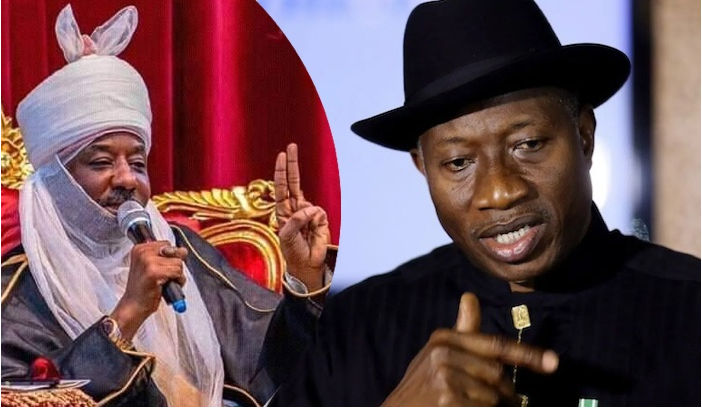
Boko Haram insurgency made Jonathan reconsider fuel subsidy removal — Emir Sanusi
The Emir of Kano, Alhaji Muhammadu Sanusi II, has disclosed that the administration of former President Goodluck Jonathan shelved its 2012 plan to completely remove fuel subsidies out of concern that Boko Haram insurgents could exploit the nationwide protests that erupted after the announcement.
Speaking at the Oxford Global Think Tank Leadership Conference, Sanusi who was the Central Bank of Nigeria (CBN) governor at the time — said the government feared potential mass casualties if extremists targeted demonstrators.
He explained that the Jonathan administration initially planned a full removal of the subsidy but later settled for a 50% cut after assessing the security risks.
“The only reason the government compromised and did 50%, not 100%, was because of Boko Haram,” Sanusi said. “There were thousands of Nigerians protesting in cities like Lagos, Kano, and Kaduna, and we already had suicide bombers in the country. If one bomber had attacked those crowds, killing hundreds, the issue would have escalated far beyond subsidy. So, I give President Jonathan credit — he was determined to act but made a responsible decision.”
Sanusi criticised Nigeria’s fuel subsidy system, describing it as a “naked hedge”, a flawed and unsustainable economic mechanism that bankrupted the country.
“It was not a subsidy; it was a hedge,” he said. “The government told Nigerians they would not pay more than a fixed amount per litre, regardless of global oil prices or exchange rates. When prices rose from $40 to $140 per barrel, the federal government paid the difference. When the exchange rate doubled, the government paid again. Eventually, we went from using revenue to pay subsidies, to borrowing money to pay subsidies, to borrowing money to pay interest on the borrowed money.”
The Emir argued that if Nigerians had allowed the Jonathan government to proceed with the full removal of fuel subsidies in 2011–2012, the economic pain would have been far less severe than the current hardship.
“If Nigerians had allowed it, inflation would have moved from 11% to 13%. I said we could bring it down later. That small pain would have saved us from today’s crisis,” he added.
Sanusi also used the platform to deliver a scathing critique of Nigeria’s political leadership, describing the country as a “classless society” where education and integrity often fail to translate into effective governance.
“If you take 109 Nigerians at random and put them in the Senate chambers, the results may not be different,” he said. “We have highly educated people in government who behave like illiterates. They forget their education once in power.”
He lamented the culture of praise-singing and corruption among public officials.
“Why would a man who is educated and accomplished become a praise singer? Why can’t he tell his boss the truth? By the time you become a governor, you should be beyond looking for money. You have the opportunity to impact millions of lives — to build schools, provide healthcare, and save lives — yet some leaders are only thinking about houses and wealth. Are you that cheap?”
Sanusi’s remarks revisited one of Nigeria’s most controversial economic moments, the 2012 Occupy Nigeria protests, which forced the Jonathan administration to reverse its plan to fully remove fuel subsidies after nationwide demonstrations paralysed the country.