
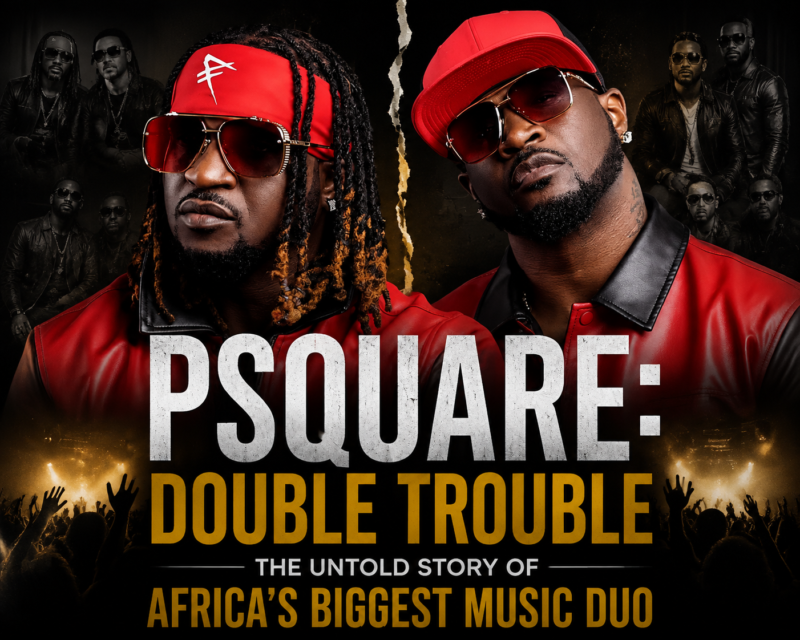
Psquare story: They were never supposed to be just one person.
From the moment they opened their eyes on the same day in November 1981, Peter and Paul Okoye shared more than a birthday. They shared a face, a heartbeat, a secret language only twins understand. In the cool highland air of Jos, two identical boys grew up finishing each other’s sentences, stealing each other’s clothes, and practising the same dance moves in the dusty courtyards of a modest Catholic home. One mirror, two reflections. One dream, two bodies determined to chase it.
No one in that quiet northern city could have predicted what those boys would become.
They started as kids mimicking Michael Jackson in school halls, spinning and sliding across concrete floors until their knees ached. They sang hymns in their mother’s church, then later turned those same voices into the soundtrack of a generation. By the mid-2000s, the name P-Square had become a force that moved continents. Stadiums packed with thousands of screaming fans. Platinum records. Songs that played in every corner of Africa and far beyond. “Bizzy Body.” “No One Like You.” “Do Me.” “E No Easy.” The list goes on — each track a chapter in the story of how two brothers from Jos rewrote the rules of African pop.
They were the perfect unit. Matching outfits. Synchronised choreography so precise it looked supernatural. Harmonies that felt like they had been rehearsed in the womb. For more than a decade they stood side by side under the brightest lights, the undisputed kings of a new Nigerian sound that the world was only beginning to notice.
But perfection has a price.
Behind the dazzling stage shows and the chart-topping hits lived a more complicated truth – one of family loyalty, ambition, money, ego, and the quiet fractures that grow when two people who once moved as one begin to want different things. The same bond that made them unstoppable would later become the source of their greatest trouble.
This is not just the story of Africa’s biggest music duo. It is the story of two boys who became legends together… and then had to learn how to become men apart.
Welcome to Double Trouble.
Watch the full story on this link https://youtu.be/E71fwoklW_E
Psquare Story – Chapter 1: Jos Beginnings
The World That Made Two Boys One
Imagine Jos in the early 1980s – a highland city of cool evenings, red earth, and the distant hum of tin mining. In a modest house, two identical boys arrived on the same November day in 1981. Peter and Paul Okoye. Same face, same birthday, same restless energy.
Their father, Mazi Moses, was a businessman who moved through the world with quiet practicality. Their mother, Josephine, was a pastor whose voice could fill a small church with hymns that lingered long after the service ended. The twins grew up in a house full of siblings – Jude, Mary, Tony, Lilian, Ifeanyi – where space was shared, arguments were loud, and affection was never far away. Faith was not abstract; it was the soundtrack of their childhood. Paul would later remember singing in his mother’s church, the smell of old hymn books, the way the congregation swayed, and the private question that sometimes surfaced: Do I belong here?
They were Igbo boys raised in the North, carrying the soft cadence of Anambra roots while learning the rhythms of Plateau life. Being identical meant they were never truly alone. One would finish the other’s sentence. One would cover for the other when mischief got out of hand. They shared clothes, secrets, and the strange comfort of looking into a mirror that could talk back. Even as children they seemed to move as a single unit – two hearts learning the same beat.
Psquare Story – Chapter 2: School, Dance & Dream
When the Stage Found Them
St. Murumba Secondary School was a small Catholic school in Jos – strict uniforms, morning assembly, the kind of place where talent had to fight for attention. Peter and Paul joined the music and drama club not because they had a grand plan, but because something in them simply needed to move and make sound.
They started the way so many young dreamers do: by copying. Michael Jackson’s sharp isolations. MC Hammer’s baggy-trouser bounce. Bobby Brown’s swagger. They mimed, they practised in empty classrooms after the bell, they argued over whose version of the moonwalk was cleaner. Friends joined them – Michael, Melvin, a boy called M Clef – and together they became an a cappella group that later turned into the Smooth Criminals. The name was pure teenage homage, a love letter to the King of Pop.
Jos noticed. At school functions and local events the twins became the ones people waited for. Their routines were precise, almost military in timing, yet full of joy. They learned to play instruments – keyboards, drums, bass, guitar – not as a career move but because the songs in their heads demanded more than voices alone. There were days they performed for almost nothing, sometimes just a bottle of Coke and applause. There were also days when the stage felt like the only place the world made complete sense.
Football tried to claim them for a while (they even trained at the Pepsi Football Academy alongside a young Mikel John Obi), but the pull of music and dance was stronger. When the Smooth Criminals eventually scattered as members left for university, the twins looked at each other and understood: whatever came next, they would face it together.
Psquare Story – Chapter 3: The Name “P-Square” & the Breakthrough
From Local Boys to the Edge of Something Bigger
After school the twins drifted through different names – Double P, P&P, Da Pees – searching for something that felt permanent. A friend named Richard finally said it out loud: P-Square. It stuck. Simple. Sharp. Twin-shaped.
They signed with a manager, Bayo Odusami (Howie T), and kept performing wherever they could. Then came the competition that changed everything: Grab Da Mic, 2001. Still in their first year studying Business Administration at the University of Abuja, they travelled back to Jos, paid for the form, and stepped onto the stage among dozens of other hopefuls. They won the northern zone. They won the Abuja final. In Lagos they became overall champions. Benson & Hedges stepped in with the kind of sponsorship most young artists only dream about.
The result was their debut album, Last Nite, released in 2003 under Timbuk2. It was not yet the polished, stadium-filling sound the world would later know, but it carried the hunger of two boys who had spent years perfecting every move in school halls and church courtyards. Singles like “Senorita” introduced the country to their blend of smooth vocals and sharp choreography. Nominations and early awards followed. Suddenly the twins from Jos were no longer just local favourites – they were standing at the threshold of a much larger stage.
Chapter 4: Get Squared (2005)
The Night the Country Started Dancing to Their Name
In May 2005 the twins walked into a new chapter carrying something heavier than an album. They had built Square Records with their own hands, a family label that felt both brave and fragile. When Get Squared dropped, it did not arrive quietly.
“Bizzy Body” hit the streets like a spark in dry grass. Suddenly every club, every party, every roadside speaker seemed to be playing the same bouncing, irresistible rhythm. Young people learned the dance. Taxi drivers sang the chorus. The twins watched their faces appear on MTV Base and stayed number one for weeks. For the first time they could feel an entire country moving in time with them.
There was joy in that moment – pure, almost childlike. The same boys who once mimed Michael Jackson in school halls were now the ones being imitated. Yet beneath the celebration sat a quiet intensity. They recorded late into the night, argued over arrangements, and trusted their elder brother Jude to capture the energy on camera. Tracks like “Temptation,” “Omoge Mi,” and the reflective “Story” showed two young men still trying to understand the size of the wave they had created.
Get Squared sold in the millions. It won them a night of glory at the first Headies. More importantly, it changed how Nigerian pop looked and sounded. The twins were no longer local talents from Jos. They had become the sound of a generation learning to dance without apology.
Chapter 5: Game Over (2007)
When the World Said Their Name Louder Than Their Own
Two years later they returned with an album that felt like a declaration. Game Over was not just music; it was a full visual experience. Nearly every song received a video, directed with cinematic ambition by Jude. The twins moved through love songs, club anthems, and quiet ballads with a new confidence.
“Do Me,” featuring a young Waje, became impossible to escape. “No One Like You” turned wedding receptions into sing-alongs across the continent. “Ifunanya” and “Roll It” kept the dance floors packed. The album reportedly moved more than eight million copies worldwide – numbers that still sound mythical in an era of physical CDs and high piracy.
Behind the numbers lived the daily reality of sudden fame. Hotel rooms that never stayed quiet. Crowds that screamed their names before they even reached the stage. The strange loneliness that can sit inside twin success – two people sharing every victory, every camera flash, every late-night conversation about what came next. They were still finishing each other’s sentences, still matching outfits, still moving as one. But the pressure of carrying an entire industry’s expectations was beginning to settle on their shoulders.
Game Over is often called their masterpiece. For the twins it was simply the moment the game truly began.
Chapter 6: Danger & Invasion (2009–2011)
Expanding the Kingdom
By 2009 they were no longer proving themselves. They were defending a throne. Danger arrived with the confidence of champions – “E No Easy” with J. Martins, “Possibility” with 2Baba, the title track that sampled Eminem with swagger. Platinum status followed quickly. The twins had become the reliable hit-makers of African pop.
Then came The Invasion in 2011, an album that reached outward. Features with Tiwa Savage, May D, and international heavyweights Akon and Rick Ross signalled a new ambition. “Beautiful Onyinye” became another wedding classic. “Chop My Money” got the Akon remix treatment and travelled further than any previous single. Signing to Akon’s Konvict Muzik and later partnering with Universal Music South Africa felt like the final confirmation: the boys from Jos now belonged on a global stage.
Yet success brought its own complications. Longer tours. Bigger budgets. More people depending on the P-Square machine. The twins still performed with the same electric chemistry, still finished each other’s dance moves without looking. But the empire was growing faster than the quiet conversations they used to have in empty rehearsal rooms.
Chapter 7: The Sound & Style
Two Bodies, One Rhythm
What made P-Square unforgettable was never just the songs. It was the complete package. Peter’s sharp, athletic choreography. Paul’s smoother vocal presence. The way they moved together – identical faces, mirrored steps, a chemistry that felt almost supernatural.
Their sound sat at a perfect crossroads: American R&B and hip-hop polished with Nigerian highlife melodies, dancehall bounce, and pure Afropop energy. They could deliver a club banger and then slide into a heartfelt ballad without breaking stride. Fashion became part of the armour – matching suits, sharp shoes, the kind of stage presence that made audiences believe they were watching royalty.
Jude’s videos turned every single into a short film. Crowds learned the dances. Young artists studied the formula. In an industry still finding its modern identity, P-Square offered a complete vision of what a Nigerian superstar could look and sound like.
Chapter 8: Building the Empire
Family, Money, and the Price of the Dream
Behind the lights stood a family business. Square Records. Real estate investments. Endorsement deals. The careful (and sometimes not-so-careful) selling of album rights to marketers in the physical-sales era. Jude handled much of the machinery while the twins remained the face and the voice.
There were nights of pure triumph – sold-out shows across Africa, Europe, and America, private jets waiting on the tarmac, the knowledge that two boys from a modest home in Jos had rewritten the possibilities for African artists. There were also the quieter, more complicated moments: conversations about money, trust, and who really controlled the brand they had built with their bodies and voices.
At the height of their powers, P-Square looked unbreakable. The golden era felt endless. Only later would the cracks become visible. For now, the twins stood at the centre of African pop, still moving as one, still believing the dream they had started in a school drama club could last forever.